
Ch 09: Work and Kinetic Energy
Knight Calc - Physics for Scientists and Engineers 5th Edition
Knight Calc5th EditionPhysics for Scientists and EngineersISBN: 9780137344796Non è quello che usi tu?Cambia libro di testo
Capitolo 9, Problema 53b

The gravitational attraction between two objects with masses mA and mB, separated by distance 𝓍, is F = GmAmB/𝓍², where G is the gravitational constant. If one mass is much greater than the other, the larger mass stays essentially at rest while the smaller mass moves toward it. Suppose a 1.5 x 10¹³ kg comet is passing the orbit of Mars, heading straight for the sun at a speed of 3.5 x 10⁴ m/s. What will its speed be when it crosses the orbit of Mercury? Astronomical data are given in the tables at the back of the book, and G = 6.67 x 10⁻¹¹ Nm²/kg².

Guida verificata passo dopo passo
1
Step 1: Identify the key variables and constants in the problem. The mass of the comet is m = 1.5 × 10¹³ kg, its initial speed is v₁ = 3.5 × 10⁴ m/s, and the gravitational constant is G = 6.67 × 10⁻¹¹ Nm²/kg². The problem involves the gravitational potential energy and kinetic energy of the comet as it moves closer to the Sun.
Step 2: Use the principle of conservation of energy. The total mechanical energy (kinetic energy + gravitational potential energy) of the comet remains constant as it moves toward the Sun. Write the equation for conservation of energy: E1 = E2 where E1 = K1 + U1 and E2 = K2 + U2 .
Step 3: Express the kinetic energy and gravitational potential energy at both points. Kinetic energy is given by K = 1 2 m v2 , and gravitational potential energy is given by U = - G m M r , where M is the mass of the Sun and r is the distance from the Sun. Substitute the values for the comet's initial and final positions (Mars and Mercury orbits) into these equations.
Step 4: Rearrange the conservation of energy equation to solve for the final speed v₂ of the comet when it crosses Mercury's orbit. The equation becomes: K1 + U1 = K2 + U2 . Substitute the expressions for kinetic and potential energy, and isolate v₂.
Step 5: Plug in the numerical values for the distances (Mars and Mercury orbits), the mass of the Sun, and the comet's mass into the equation. Perform algebraic manipulations to simplify the equation and solve for v₂. This will give the comet's speed when it crosses Mercury's orbit.

Risposta video verificata per un problema simile:

Questa soluzione video è stata consigliata dai nostri tutor come utile per risolvere questo problema.
Durata del video:
13m

Concetti chiave

Ecco i concetti essenziali che devi comprendere per rispondere correttamente alla domanda.

Gravitational Force

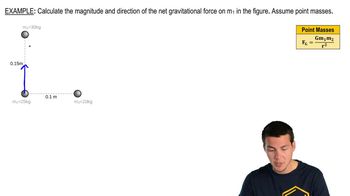
The gravitational force is the attractive force between two masses, described by Newton's law of universal gravitation. It states that the force (F) is proportional to the product of the two masses (mᴀ and mᴃ) and inversely proportional to the square of the distance (𝓍) between their centers. This relationship is quantified by the gravitational constant (G), which has a value of approximately 6.67 x 10⁻¹¹ Nm²/kg².
Video consigliato:
Percorso guidato
05:41
Gravitational Forces in 2D

Conservation of Energy

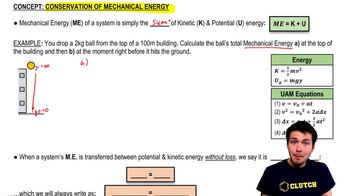
The principle of conservation of energy states that the total energy in a closed system remains constant over time. In the context of gravitational interactions, as an object moves in a gravitational field, its potential energy decreases while its kinetic energy increases, ensuring that the total mechanical energy (kinetic + potential) remains constant. This principle is crucial for calculating the speed of the comet as it approaches the sun.
Video consigliato:
Percorso guidato
06:24
Conservation Of Mechanical Energy

Kinetic and Potential Energy

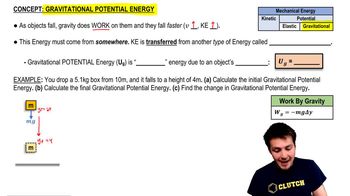
Kinetic energy is the energy of an object due to its motion, calculated as KE = 1/2 mv², where m is mass and v is velocity. Potential energy in a gravitational field is given by PE = -G(m₁m₂)/r, where m₁ and m₂ are the masses and r is the distance between them. As the comet approaches the sun, its potential energy decreases while its kinetic energy increases, leading to a change in speed that can be calculated using these energy concepts.
Video consigliato:
Percorso guidato
06:35
Gravitational Potential Energy
Pratica correlata
Domanda del libro di testo

A 50 kg ice skater is gliding along the ice, heading due north at 4.0 m/s. The ice has a small coefficient of static friction, to prevent the skater from slipping sideways, but μk = 0. Suddenly, a wind from the northeast exerts a force of 4.0 N on the skater. What is the minimum value of μs that allows her to continue moving straight north?

642
views
Domanda del libro di testo

A 50 g rock is placed in a slingshot and the rubber band is stretched. The magnitude of the force of the rubber band on the rock is shown by the graph in FIGURE P9.56. The rubber band is stretched 30 cm and then released. What is the speed of the rock?

2103
views
1
rank
Domanda del libro di testo

A red ball has a mass of 250 g. A constant force pushes the red ball horizontally and launches it at a speed of 15 m/s. The same force pushes a green ball through the same distance, launching it at 25 m/s. What is the mass of the green ball?

2195
views
Domanda del libro di testo

A 30 g mass is attached to one end of a 10-cm-long spring. The other end of the spring is connected to a frictionless pivot on a frictionless, horizontal surface. Spinning the mass around in a circle at 90 rpm causes the spring to stretch to a length of 12 cm. What is the value of the spring constant?

2375
views
Domanda del libro di testo

A 50 kg ice skater is gliding along the ice, heading due north at 4.0 m/s. The ice has a small coefficient of static friction, to prevent the skater from slipping sideways, but μk = 0. Suddenly, a wind from the northeast exerts a force of 4.0 N on the skater. Use work and energy to find the skater's speed after gliding 100 m in this wind.

2734
views
Domanda del libro di testo

A 737-800 jet airliner has twin engines, each with 105 kN thrust. A 78,000 kg jet reaches a takeoff speed of 70 m/s in a distance of 1100 m. What is the increase in thermal energy due to rolling friction and air drag?

3052
views