Ch 10: Interactions and Potential Energy
Knight Calc - Physics for Scientists and Engineers 5th Edition
Knight Calc5th EditionPhysics for Scientists and EngineersISBN: 9780137344796Non è quello che usi tu?Cambia libro di testo
Capitolo 10, Problema 56a

A sled starts from rest at the top of the frictionless, hemispherical, snow-covered hill shown in FIGURE P10.56. a. Find an expression for the sled's speed when it is at angle ϕ .

Guida verificata passo dopo passo
1
Step 1: Begin by identifying the key principles involved in the problem. Since the sled starts from rest and the hill is frictionless, we can use the conservation of mechanical energy to solve the problem. The total mechanical energy (potential energy + kinetic energy) remains constant throughout the motion.
Step 2: Write the expression for the total mechanical energy at the top of the hill. At the top, the sled has only gravitational potential energy, which is given by \( U = m g h \), where \( h \) is the height of the hill. Since the hill is hemispherical, \( h = R \), where \( R \) is the radius of the hemisphere.
Step 3: Write the expression for the total mechanical energy at the angle \( \phi \). At this point, the sled has both kinetic energy \( K = \frac{1}{2} m v^2 \) and gravitational potential energy \( U = m g h \). The height \( h \) at angle \( \phi \) can be expressed as \( h = R \cos \phi \).
Step 4: Apply the conservation of mechanical energy principle. Equate the total energy at the top of the hill to the total energy at angle \( \phi \): \( m g R = \frac{1}{2} m v^2 + m g R \cos \phi \).
Step 5: Solve for the sled's speed \( v \) at angle \( \phi \). Rearrange the equation to isolate \( v \): \( v = \sqrt{2 g R (1 - \cos \phi)} \). This is the expression for the sled's speed at angle \( \phi \).

Risposta video verificata per un problema simile:

Questa soluzione video è stata consigliata dai nostri tutor come utile per risolvere questo problema.

Concetti chiave

Ecco i concetti essenziali che devi comprendere per rispondere correttamente alla domanda.

Conservation of Energy

The principle of conservation of energy states that the total mechanical energy of an isolated system remains constant if only conservative forces are acting. In this scenario, as the sled descends the hill, its potential energy is converted into kinetic energy, allowing us to relate the sled's height at angle ϕ to its speed.
Video consigliato:
Percorso guidato
06:24
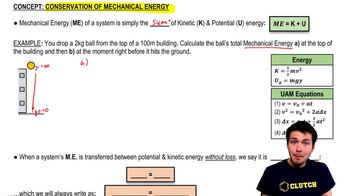
Conservation Of Mechanical Energy

Kinetic and Potential Energy

Kinetic energy (KE) is the energy of an object due to its motion, given by the formula KE = 1/2 mv², where m is mass and v is velocity. Potential energy (PE), particularly gravitational potential energy, is the energy stored due to an object's position in a gravitational field, calculated as PE = mgh, where h is height. Understanding these forms of energy is crucial for analyzing the sled's motion.
Video consigliato:
Percorso guidato
06:35
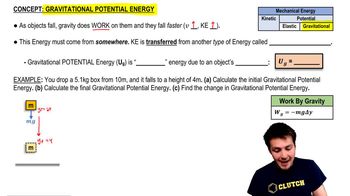
Gravitational Potential Energy

Centripetal Force

Centripetal force is the net force required to keep an object moving in a circular path and is directed towards the center of the circle. In this problem, as the sled moves along the hemispherical hill, the gravitational force provides the necessary centripetal force to maintain its circular motion at angle ϕ, which is essential for determining the sled's speed.
Video consigliato:
Percorso guidato
06:48
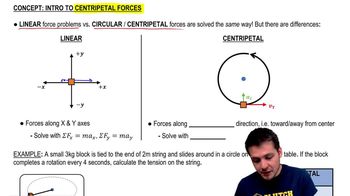
Intro to Centripetal Forces
Pratica correlata
Domanda del libro di testo

A 1.0 kg mass that can move along the x-axis experiences the potential energy U = (x²−x) J, where x is in m. The mass has velocity vx = 3.0 m/s at position x = 1.0 m. At what position has it slowed to 1.0 m/s?

1768
views

Domanda del libro di testo

A system has potential energy U(x)=(10J)[1−sin((3.14rad/m)x)]U(x) = (10 \, \(\text{J}\)) [1 - \(\sin\)((3.14 \, \(\text{rad/m}\)) x)] as a particle moves over the range 0 m ≤x≤3 m0\(\text{ m }\)\(\le\) x\(\le\)3\(\text{ m}\). For each, is it a point of stable or unstable equilibrium?

2774
views
Domanda del libro di testo

The spring shown in FIGURE P10.54 is compressed 50 cm and used to launch a 100 kg physics student. The track is frictionless until it starts up the incline. The student's coefficient of kinetic friction on the 30° incline is 0.15. What is the student's speed just after losing contact with the spring?

<Image>

2814
views
Domanda del libro di testo

FIGURE 10.23 showed the potential-energy curve for the O2 molecule. Consider a molecule with the energy E1 shown in the figure. a. What is the maximum speed of an oxygen atom as it oscillates back and forth? Don't forget that the kinetic energy is the total kinetic energy of the system. The mass of an oxygen atom is 16 u, where 1u=1 atomic mass unit =1.66×10⁻²⁷ kg .

2633
views
Domanda del libro di testo

CALC A 2.6 kg block is attached to a horizontal rope that exerts a variable force Fx = (20 − 5x) N, where x is in m. The coefficient of kinetic friction between the block and the floor is 0.25. Initially the block is at rest at x = 0 m. What is the block's speed when it has been pulled to x = 4.0 m?

3099
views
Domanda del libro di testo

The ice cube is replaced by a 50 g plastic cube whose coefficient of kinetic friction is 0.20. How far will the plastic cube travel up the slope? Use work and energy.

1979
views