
Ch 10: Interactions and Potential Energy
Knight Calc - Physics for Scientists and Engineers 5th Edition
Knight Calc5th EditionPhysics for Scientists and EngineersISBN: 9780137344796Non è quello che usi tu?Cambia libro di testo
Capitolo 10, Problema 17

A stretched spring stores 2.0 J of energy. How much energy will be stored if the spring is stretched three times as far?

Guida verificata passo dopo passo
1
Understand that the energy stored in a spring is given by the formula: Es = 12kx2, where k is the spring constant and x is the displacement from the equilibrium position.
Recognize that the energy stored in the spring is proportional to the square of the displacement, as indicated by the x2 term in the formula.
If the spring is stretched three times as far, the new displacement becomes x' = 3x. Substitute this into the energy formula: Es' = 12k(3x)2.
Simplify the expression for the new energy: Es' = 12k(9x2) = 912kx2.
Compare the new energy to the original energy. Since the original energy is Es = 12kx2, the new energy is 9 times the original energy. Multiply the original energy (2.0 J) by 9 to find the new energy.

Risposta video verificata per un problema simile:

Questa soluzione video è stata consigliata dai nostri tutor come utile per risolvere questo problema.
Durata del video:
4m

Concetti chiave

Ecco i concetti essenziali che devi comprendere per rispondere correttamente alla domanda.

Hooke's Law

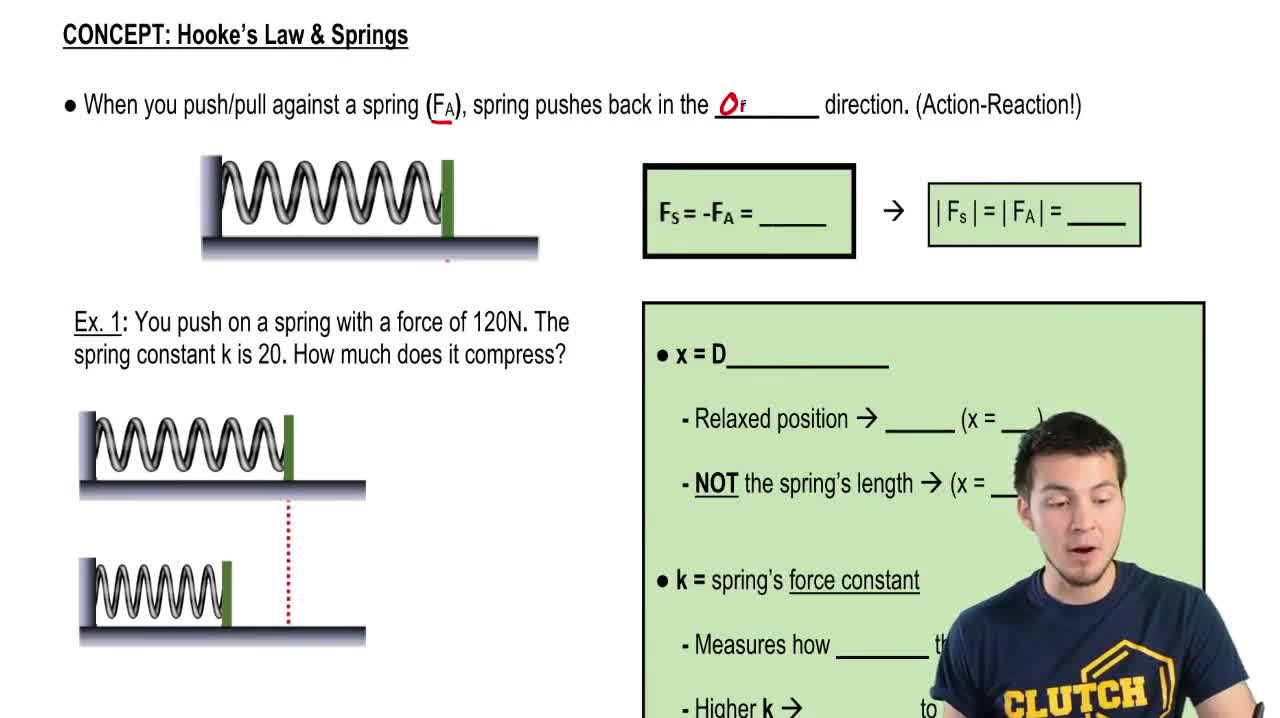
Hooke's Law states that the force exerted by a spring is directly proportional to the distance it is stretched or compressed from its equilibrium position, represented mathematically as F = kx, where F is the force, k is the spring constant, and x is the displacement. This principle is fundamental in understanding how springs behave under different loads.
Video consigliato:
Percorso guidato
05:27
Spring Force (Hooke's Law)

Elastic Potential Energy

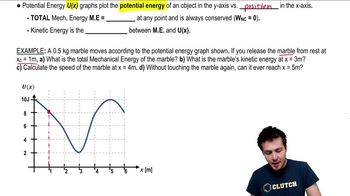
Elastic potential energy is the energy stored in a spring when it is stretched or compressed. The formula for elastic potential energy (U) is U = 1/2 kx², where k is the spring constant and x is the displacement from the equilibrium position. This concept is crucial for calculating the energy stored in a spring based on its deformation.
Video consigliato:
Percorso guidato
07:24
Potential Energy Graphs

Energy Scaling with Displacement

The energy stored in a spring scales with the square of the displacement. This means that if the displacement is tripled, the energy stored increases by a factor of nine (since (3x)² = 9x²). Understanding this relationship is essential for predicting how much energy will be stored when the spring is stretched to different lengths.
Video consigliato:
Percorso guidato
06:13
Displacement vs. Distance
Pratica correlata
Domanda del libro di testo

The elastic energy stored in your tendons can contribute up to 35% of your energy needs when running. Sports scientists find that (on average) the knee extensor tendons in sprinters stretch 41 mm while those of nonathletes stretch only 33 mm. The spring constant of the tendon is the same for both groups, 33 N/mm. What is the difference in maximum stored energy between the sprinters and the nonathletes?

3272
views
Domanda del libro di testo

As a 15,000 kg jet plane lands on an aircraft carrier, its tail hook snags a cable to slow it down. The cable is attached to a spring with spring constant 60,000 N/m. If the spring stretches 30 m to stop the plane, what was the plane's landing speed?

1598
views
Domanda del libro di testo

The maximum energy a bone can absorb without breaking is surprisingly small. Experimental data show that a leg bone of a healthy, 60 kg human can absorb about 200 J. From what maximum height could a 60 kg person jump and land rigidly upright on both feet without breaking his legs? Assume that all energy is absorbed by the leg bones in a rigid landing.

3449
views
Domanda del libro di testo

FIGURE EX10.24 is the potential-energy diagram for a 500 g particle that is released from rest at A. What are the particle's speeds at B, C, and D?

2344
views
Domanda del libro di testo

In a hydroelectric dam, water falls 25 m and then spins a turbine to generate electricity. Suppose the dam is 80% efficient at converting the water's potential energy to electrical energy. How many kilograms of water must pass through the turbines each second to generate 50 MW of electricity? This is a typical value for a small hydroelectric dam.

2331
views
Domanda del libro di testo

In a hydroelectric dam, water falls 25 m and then spins a turbine to generate electricity. What is ΔUG\(\Delta\) U_{G} of 1.0 kg of water?

2224
views