Ch 10: Interactions and Potential Energy
Knight Calc - Physics for Scientists and Engineers 5th Edition
Knight Calc5th EditionPhysics for Scientists and EngineersISBN: 9780137344796Non è quello che usi tu?Cambia libro di testo
Capitolo 10, Problema 71

In a physics lab experiment, a compressed spring launches a 20 g metal ball at a 30° angle. Compressing the spring 20 cm causes the ball to hit the floor 1.5 m below the point at which it leaves the spring after traveling 5.0 m horizontally. What is the spring constant?

Guida verificata passo dopo passo
1
Convert all given quantities to SI units: the mass of the ball is \( m = 0.020 \; \text{kg} \), the spring compression is \( x = 0.20 \; \text{m} \), the horizontal distance is \( R = 5.0 \; \text{m} \), and the vertical displacement is \( \Delta y = -1.5 \; \text{m} \).
Use the horizontal motion equation \( R = v_x t \) to express the time of flight \( t \) in terms of the horizontal velocity \( v_x = v \cos \theta \), where \( v \) is the initial velocity and \( \theta = 30^\circ \). Rearrange to find \( t = \frac{R}{v \cos \theta} \).
Use the vertical motion equation \( \Delta y = v_y t - \frac{1}{2} g t^2 \), where \( v_y = v \sin \theta \) is the vertical velocity. Substitute \( t = \frac{R}{v \cos \theta} \) into this equation to solve for \( v \), the initial velocity.
Relate the initial velocity \( v \) to the spring's potential energy using the conservation of energy principle: \( \frac{1}{2} k x^2 = \frac{1}{2} m v^2 \), where \( k \) is the spring constant. Rearrange this equation to solve for \( k \): \( k = \frac{m v^2}{x^2} \).
Substitute the value of \( v \) obtained from the kinematic equations and the given quantities into the expression for \( k \) to calculate the spring constant.

Risposta video verificata per un problema simile:

Questa soluzione video è stata consigliata dai nostri tutor come utile per risolvere questo problema.
Durata del video:
15m

Concetti chiave

Ecco i concetti essenziali che devi comprendere per rispondere correttamente alla domanda.

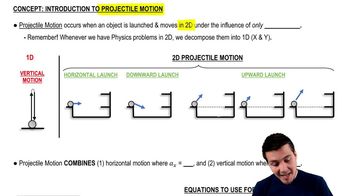
Projectile Motion

Projectile motion refers to the motion of an object that is launched into the air and is subject to gravitational forces. It can be analyzed in two dimensions: horizontal and vertical. The horizontal motion is uniform, while the vertical motion is influenced by gravity, leading to a parabolic trajectory. Understanding the components of projectile motion is essential for determining the range and height of the launched object.
Video consigliato:
Percorso guidato
04:44
Introduction to Projectile Motion

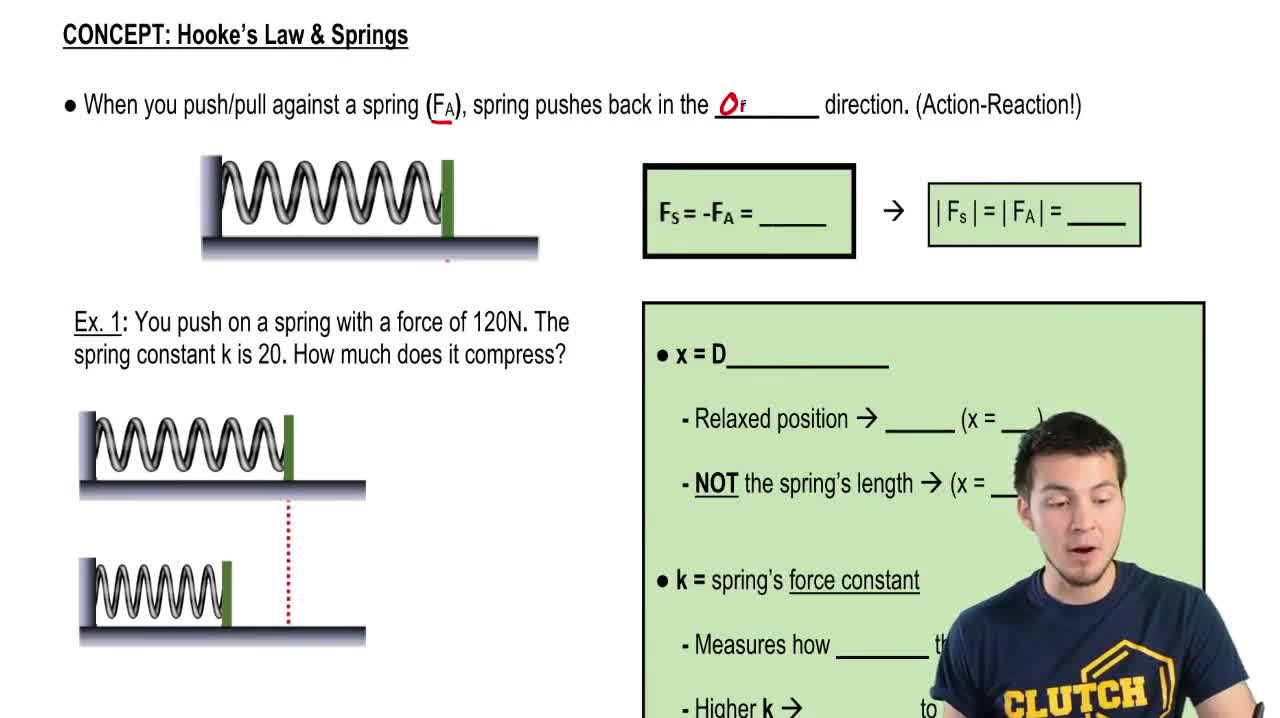
Spring Constant (Hooke's Law)

The spring constant, denoted as 'k', is a measure of a spring's stiffness and is defined by Hooke's Law, which states that the force exerted by a spring is proportional to its displacement from the equilibrium position. Mathematically, F = -kx, where F is the force, k is the spring constant, and x is the displacement. This concept is crucial for calculating the potential energy stored in a compressed spring, which is converted into kinetic energy when the spring is released.
Video consigliato:
Percorso guidato
05:27
Spring Force (Hooke's Law)

Energy Conservation

The principle of energy conservation states that energy cannot be created or destroyed, only transformed from one form to another. In the context of the spring and the ball, the potential energy stored in the compressed spring is converted into kinetic energy as the ball is launched. Additionally, the ball's kinetic energy is transformed into gravitational potential energy as it rises and then back into kinetic energy as it falls, which is vital for solving the problem of finding the spring constant.
Video consigliato:
Percorso guidato
06:24
Conservation Of Mechanical Energy