Ch 10: Interactions and Potential Energy
Knight Calc - Physics for Scientists and Engineers 5th Edition
Knight Calc5th EditionPhysics for Scientists and EngineersISBN: 9780137344796Non è quello che usi tu?Cambia libro di testo
Capitolo 10, Problema 29

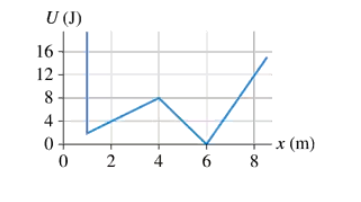
In FIGURE EX10.28, what is the maximum speed a 200 g particle could have at x = 2.0 m and never reach x = 6.0 m?

Guida verificata passo dopo passo
1
Step 1: Analyze the graph provided. The graph shows the potential energy U(x) as a function of position x. At x = 2.0 m, U(x) = 0 J, and at x = 6.0 m, U(x) = 4 J. The particle's total mechanical energy must be less than or equal to 4 J to ensure it does not reach x = 6.0 m.
Step 2: Use the principle of conservation of mechanical energy. The total mechanical energy E is the sum of the kinetic energy K and potential energy U. At x = 2.0 m, the potential energy U is 0 J, so the total energy E is equal to the kinetic energy K at this position.
Step 3: Write the expression for kinetic energy K: \( K = \frac{1}{2} m v^2 \), where m is the mass of the particle and v is its speed. The mass of the particle is given as 200 g, which should be converted to kilograms: \( m = 0.2 \, \text{kg} \).
Step 4: Set the total energy E equal to the maximum allowable energy (4 J) to ensure the particle does not reach x = 6.0 m. Solve for the maximum speed v using \( E = \frac{1}{2} m v^2 \). Rearrange the equation to find \( v = \sqrt{\frac{2E}{m}} \).
Step 5: Substitute the values for E (4 J) and m (0.2 kg) into the equation \( v = \sqrt{\frac{2E}{m}} \). This will give the maximum speed the particle can have at x = 2.0 m without reaching x = 6.0 m.

Risposta video verificata per un problema simile:

Questa soluzione video è stata consigliata dai nostri tutor come utile per risolvere questo problema.
Durata del video:
4m

Concetti chiave

Ecco i concetti essenziali che devi comprendere per rispondere correttamente alla domanda.

Potential Energy (U)

Potential energy is the energy stored in an object due to its position in a force field, such as gravitational or elastic fields. In the context of the graph, it represents the energy of the particle at various positions along the x-axis. The height of the curve indicates the potential energy at each position, which influences the particle's ability to move to different locations.
Video consigliato:
Percorso guidato
06:35
Gravitational Potential Energy

Conservation of Energy

The principle of conservation of energy states that the total energy in a closed system remains constant. For the particle in the problem, the sum of its kinetic energy and potential energy must equal a constant value. This means that as the particle moves, any change in potential energy will result in a corresponding change in kinetic energy, affecting its speed at different positions.
Video consigliato:
Percorso guidato
06:24
Conservation Of Mechanical Energy

Kinetic Energy (KE)

Kinetic energy is the energy of an object due to its motion, calculated using the formula KE = 1/2 mv², where m is mass and v is velocity. In this problem, the maximum speed of the particle at x = 2.0 m can be determined by considering the potential energy at that point and ensuring that the particle has enough kinetic energy to not reach x = 6.0 m, where the potential energy is higher.
Video consigliato:
Percorso guidato
06:07
Intro to Rotational Kinetic Energy