
Ch 10: Interactions and Potential Energy
Knight Calc - Physics for Scientists and Engineers 5th Edition
Knight Calc5th EditionPhysics for Scientists and EngineersISBN: 9780137344796Non è quello che usi tu?Cambia libro di testo
Capitolo 10, Problema 4

The free-fall acceleration on a large asteroid, in the vacuum of space, is 0.15 m/s2. A spacecraft hovering 500 m above the surface drops a 25 kg payload wrapped in a padded jacket. What is the payload's impact speed?

Guida verificata passo dopo passo
1
Identify the known values: The free-fall acceleration \( g = 0.15 \; \text{m/s}^2 \), the initial height \( h_0 = 500 \; \text{m} \), and the initial velocity \( v_0 = 0 \; \text{m/s} \) since the payload is dropped from rest.
Use the kinematic equation \( v^2 = v_0^2 + 2gh \) to find the final velocity \( v \) of the payload just before impact. Here, \( v_0 = 0 \), \( g = 0.15 \; \text{m/s}^2 \), and \( h = 500 \; \text{m} \).
Substitute the known values into the equation: \( v^2 = 0 + 2(0.15)(500) \). Simplify the expression to find \( v^2 \).
Take the square root of both sides to solve for \( v \): \( v = \sqrt{2(0.15)(500)} \).
Interpret the result: The value of \( v \) represents the impact speed of the payload just before it hits the surface of the asteroid.

Risposta video verificata per un problema simile:

Questa soluzione video è stata consigliata dai nostri tutor come utile per risolvere questo problema.
Durata del video:
4m

Concetti chiave

Ecco i concetti essenziali che devi comprendere per rispondere correttamente alla domanda.

Free-Fall Acceleration

Free-fall acceleration refers to the acceleration of an object due solely to the force of gravity acting on it, without any other forces like air resistance. On the asteroid mentioned, this acceleration is 0.15 m/s², which is significantly lower than Earth's 9.81 m/s². This means that objects will fall more slowly on the asteroid, affecting their impact speed.
Video consigliato:
Percorso guidato
08:36
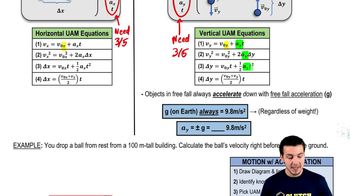
Vertical Motion & Free Fall

Kinematic Equations

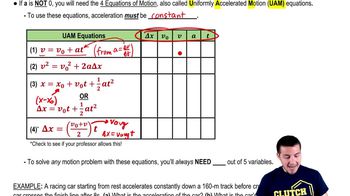
Kinematic equations describe the motion of objects under constant acceleration. In this scenario, we can use the equation v² = u² + 2as, where v is the final velocity, u is the initial velocity (0 m/s for a dropped object), a is the acceleration (0.15 m/s²), and s is the distance fallen (500 m). This equation allows us to calculate the impact speed of the payload.
Video consigliato:
Percorso guidato
08:25
Kinematics Equations

Impact Speed

Impact speed is the velocity of an object just before it collides with another object or surface. It is influenced by the height from which the object is dropped and the acceleration due to gravity. In this case, calculating the impact speed of the payload involves determining how fast it is moving just before it hits the surface of the asteroid after falling 500 m.
Video consigliato:
Percorso guidato
07:59
Speed Distribution & Special Speeds of Ideal Gases