
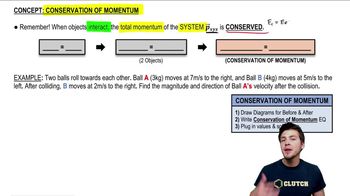
Two 500 g blocks of wood are 2.0 m apart on a frictionless table. A 10 g bullet is fired at 400 m/s toward the blocks. It passes all the way through the first block, then embeds itself in the second block. The speed of the first block immediately afterward is 6.0 m/s . What is the speed of the second block after the bullet stops in it?
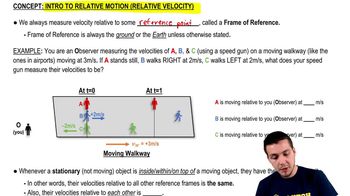
A 30 ton rail car and a 90 ton rail car, initially at rest, are connected together with a giant but massless compressed spring between them. When released, the 30 ton car is pushed away at a speed of 4.0 m/s relative to the 90 ton car. What is the speed of the 30 ton car relative to the ground?
Guida verificata passo dopo passo
Risposta video verificata per un problema simile:
Concetti chiave
Conservation of Momentum
Relative Velocity
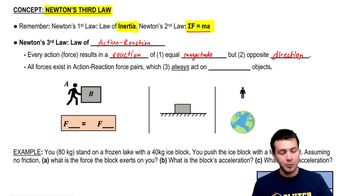
Newton's Third Law of Motion
A 100 g ball moving to the right at 4.0 m/s collides head-on with a 200g ball that is moving to the left at 3.0 m/s. If the collision is perfectly elastic, what are the speed and direction of each ball after the collision?
A 500 g particle has velocity vx = −5.0 m/s at t = −2 s. Force Fx = (4−t2) N, where t is in s, is exerted on the particle between t = −2 s and t = 2 s. This force increases from 0 N at t = −2 s to 4 N at t = 0 s and then back to 0 N at t = 2 s. What is the particle's velocity at t = 2s?
The stoplight had just changed and a 2000 kg Cadillac had entered the intersection, heading north at 3.0 m/s , when it was struck by a 1000 kg eastbound Volkswagen. The cars stuck together and slid to a halt, leaving skid marks angled 35° north of east. How fast was the Volkswagen going just before the impact?
Consider a partially elastic collision in which ball A of mass m with initial velocity (vix)A collides with stationary ball B, also of mass m, and in which 1/4 of the mechanical energy is dissipated as thermal energy. Find expressions for the final velocities of each ball. Hint: Mathematically there are two solutions; however, one of them is physically impossible.
One end of a massless, 30-cm-long spring with spring constant 15 N/m is attached to a 250 g stationary air-track glider; the other end is attached to the track. A 500 g glider hits and sticks to the 250 g glider, compressing the spring to a minimum length of 22 cm. What was the speed of the 500 g glider just before impact?
