Ch 11: Impulse and Momentum
Knight Calc - Physics for Scientists and Engineers 5th Edition
Knight Calc5th EditionPhysics for Scientists and EngineersISBN: 9780137344796Non è quello che usi tu?Cambia libro di testo
Capitolo 11, Problema 22

A proton is traveling to the right at 2.0 x 10⁷ m/s. It has a head-on perfectly elastic collision with a carbon atom. The mass of the carbon atom is 12 times the mass of the proton. What are the speed and direction of each after the collision?

Guida verificata passo dopo passo
1
Step 1: Recognize that this is a perfectly elastic collision, meaning both momentum and kinetic energy are conserved. Let the mass of the proton be mₚ and the mass of the carbon atom be mₐ = 12mₚ. Let the initial velocity of the proton be vₚ₁ = 2.0 × 10⁷ m/s, and the initial velocity of the carbon atom be vₐ₁ = 0 m/s (since it is initially at rest).
Step 2: Write the equation for conservation of momentum: mₚvₚ₁ + mₐvₐ₁ = mₚvₚ₂ + mₐvₐ₂, where vₚ₂ and vₐ₂ are the final velocities of the proton and carbon atom, respectively. Substitute the known values: mₚ(2.0 × 10⁷) + 12mₚ(0) = mₚvₚ₂ + 12mₚvₐ₂.
Step 3: Simplify the momentum equation by canceling out mₚ (since it is common to all terms): 2.0 × 10⁷ = vₚ₂ + 12vₐ₂. This is the first equation relating vₚ₂ and vₐ₂.
Step 4: Write the equation for conservation of kinetic energy: (1/2)mₚvₚ₁² + (1/2)mₐvₐ₁² = (1/2)mₚvₚ₂² + (1/2)mₐvₐ₂². Substitute the known values: (1/2)mₚ(2.0 × 10⁷)² + (1/2)(12mₚ)(0)² = (1/2)mₚvₚ₂² + (1/2)(12mₚ)vₐ₂².
Step 5: Simplify the kinetic energy equation by canceling out (1/2)mₚ: (2.0 × 10⁷)² = vₚ₂² + 12vₐ₂². This is the second equation relating vₚ₂ and vₐ₂. Solve the system of equations from Step 3 and Step 5 to find the final velocities vₚ₂ and vₐ₂. The direction of each particle can be determined from the signs of their velocities.

Risposta video verificata per un problema simile:

Questa soluzione video è stata consigliata dai nostri tutor come utile per risolvere questo problema.
Durata del video:
15m

Concetti chiave

Ecco i concetti essenziali che devi comprendere per rispondere correttamente alla domanda.

Conservation of Momentum

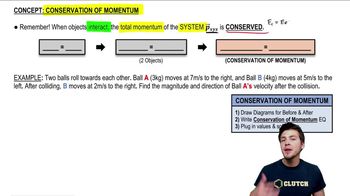
In a collision, the total momentum of a system remains constant if no external forces act on it. This principle allows us to relate the velocities of the colliding objects before and after the collision. For a perfectly elastic collision, the momentum before the collision equals the momentum after the collision, which can be expressed mathematically as m1*v1 + m2*v2 = m1*v1' + m2*v2', where m is mass and v is velocity.
Video consigliato:
Percorso guidato
05:58
Conservation Of Momentum

Elastic Collision

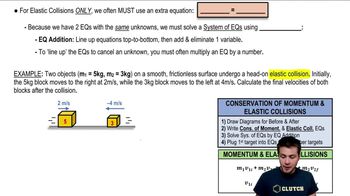
An elastic collision is one in which both momentum and kinetic energy are conserved. In such collisions, the objects bounce off each other without any loss of kinetic energy. This is crucial for solving the problem, as it allows us to use both conservation laws to find the final velocities of the proton and the carbon atom after their interaction.
Video consigliato:
Percorso guidato
08:56
Intro To Elastic Collisions

Mass Ratio and Velocity Relationship

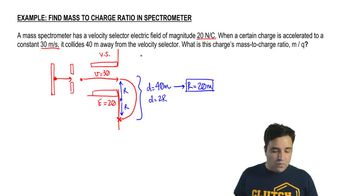
The mass ratio between colliding objects significantly affects their post-collision velocities. In this scenario, the carbon atom's mass is 12 times that of the proton, which means it will have a much smaller change in velocity compared to the proton. Understanding how mass influences the final speeds and directions of the objects is essential for accurately calculating their outcomes after the collision.
Video consigliato:
Percorso guidato
04:12
Find Mass-to-Charge Ratio in Spectrometer
Pratica correlata
Domanda del libro di testo

A 30 g dart traveling horizontally hits and sticks in the back of a 500 g toy car, causing the car to roll forward at 1.4 m/s. What was the speed of the dart?

1928
views

Domanda del libro di testo

A 1500 kg car is rolling at 2.0 m/s. You would like to stop the car by firing a 10 kg blob of sticky clay at it. How fast should you fire the clay?

1856
views
Domanda del libro di testo

Fred (mass 60 kg) is running with the football at a speed of 6.0 m/s when he is met head-on by Brutus (mass 120 kg), who is moving at 4.0 m/s. Brutus grabs Fred in a tight grip, and they fall to the ground. Which way do they slide, and how far? The coefficient of kinetic friction between football uniforms and Astroturf is 0.30.

2743
views
Domanda del libro di testo

A 50 g ball of clay traveling at speed v0 hits and sticks to a 1.0 kg brick sitting at rest on a frictionless surface. What is the speed of the brick after the collision?

1762
views
Domanda del libro di testo

A 50 g marble moving at 2.0 m/s strikes a 20 g marble at rest. What is the speed of each marble immediately after the collision?

2926
views
1
rank
Domanda del libro di testo

A package of mass m is released from rest at a warehouse loading dock and slides down the 3.0-m-high, frictionless chute of FIGURE EX11.24 to a waiting truck. Unfortunately, the truck driver went on a break without having removed the previous package, of mass 2m, from the bottom of the chute. Suppose the collision between the packages is perfectly elastic. To what height does the package of mass m rebound?

477
views