
A bullet of mass m is fired into a block of mass M that is at rest. The block, with the bullet embedded, slides distance d across a horizontal surface. The coefficient of kinetic friction is μk .Find an expression for the bullet's speed vbullet.
An object at rest on a flat, horizontal surface explodes into two fragments, one seven times as massive as the other. The heavier fragment slides 8.2 m before stopping. How far does the lighter fragment slide? Assume that both fragments have the same coefficient of kinetic friction.
Guida verificata passo dopo passo
Risposta video verificata per un problema simile:
Concetti chiave
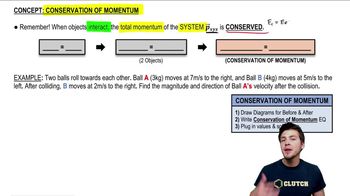
Conservation of Momentum
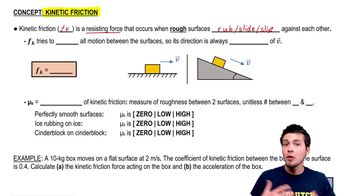
Friction and Kinetic Friction Coefficient
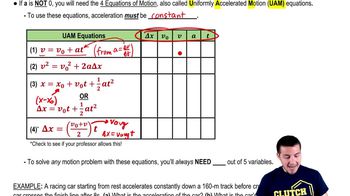
Kinematic Equations
Two 500 g blocks of wood are 2.0 m apart on a frictionless table. A 10 g bullet is fired at 400 m/s toward the blocks. It passes all the way through the first block, then embeds itself in the second block. The speed of the first block immediately afterward is 6.0 m/s . What is the speed of the second block after the bullet stops in it?
The stoplight had just changed and a 2000 kg Cadillac had entered the intersection, heading north at 3.0 m/s , when it was struck by a 1000 kg eastbound Volkswagen. The cars stuck together and slid to a halt, leaving skid marks angled 35° north of east. How fast was the Volkswagen going just before the impact?
A 1500 kg weather rocket accelerates upward at 10 m/s². It explodes 2.0 s after liftoff and breaks into two fragments, one twice as massive as the other. Photos reveal that the lighter fragment traveled straight up and reached a maximum height of 530 m. What were the speed and direction of the heavier fragment just after the explosion?
What is the speed of a 10g bullet that, when fired into a 10kg stationary wood block, causes the block to slide 5.0 cm across a wood table?
BIO Squids rely on jet propulsion to move around. A 1.50 kg squid (including the mass of water inside the squid) drifting at 0.40m/s suddenly ejects 0.100 kg of water to get itself moving at 2.50m/s . If drag is ignored over the small interval of time needed to expel the water (the impulse approximation), what is the water’s ejection speed relative to the squid?
