
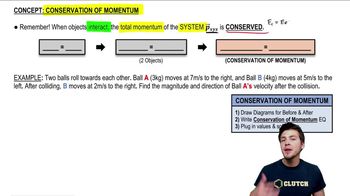
A 100 g ball moving to the right at 4.0 m/s collides head-on with a 200g ball that is moving to the left at 3.0 m/s. If the collision is perfectly elastic, what are the speed and direction of each ball after the collision?
The nucleus of the polonium isotope ²¹⁴Po (mass 214 u) is radioactive and decays by emitting an alpha particle (a helium nucleus with mass 4 u). Laboratory experiments measure the speed of the alpha particle to be 1.92×10⁷ m/s . Assuming the polonium nucleus was initially at rest, what is the recoil speed of the nucleus that remains after the decay?
Guida verificata passo dopo passo
Risposta video verificata per un problema simile:
Concetti chiave
Conservation of Momentum
Alpha Decay
Kinetic Energy
Consider a partially elastic collision in which ball A of mass m with initial velocity (vix)A collides with stationary ball B, also of mass m, and in which 1/4 of the mechanical energy is dissipated as thermal energy. Find expressions for the final velocities of each ball. Hint: Mathematically there are two solutions; however, one of them is physically impossible.
A 45 g projectile explodes into three pieces: a 20 g piece with velocity 25 î m/s, a 15 g piece with velocity −10 î + 10ĵ m/s, and a 10 g piece with velocity −15 î − 20ĵ m/s. What was the projectile's velocity just before the explosion?
A white ball traveling at 2.0m/s hits an equal-mass red ball at rest. The white ball is deflected by 25° and slowed to 1.5m/s. What percentage of the initial mechanical energy is lost in the collision?
One end of a massless, 30-cm-long spring with spring constant 15 N/m is attached to a 250 g stationary air-track glider; the other end is attached to the track. A 500 g glider hits and sticks to the 250 g glider, compressing the spring to a minimum length of 22 cm. What was the speed of the 500 g glider just before impact?
A neutron is an electrically neutral subatomic particle with a mass just slightly greater than that of a proton. A free neutron is radioactive and decays after a few minutes into other subatomic particles. In one experiment, a neutron at rest was observed to decay into a proton (mass 1.67×10⁻²⁷ kg) and an electron (mass 9.11×10⁻³¹ kg) . The proton and electron were shot out back-to-back. The proton speed was measured to be 1.0 ×10⁵ m/s, and the electron speed was 3.0×10⁷ m/s. No other decay products were detected. How much momentum did this neutrino 'carry away' with it?
