Ch 12: Rotation of a Rigid Body
Knight Calc - Physics for Scientists and Engineers 5th Edition
Knight Calc5th EditionPhysics for Scientists and EngineersISBN: 9780137344796Non è quello che usi tu?Cambia libro di testo
Capitolo 12, Problema 64a

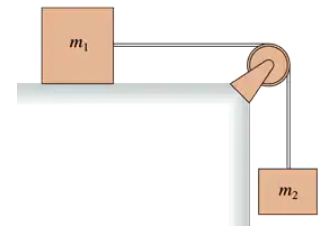
Blocks of mass m₁ and m₂ are connected by a massless string that passes over the pulley in FIGURE P12.64. The pulley turns on frictionless bearings. Mass m₁ slides on a horizontal, frictionless surface. Mass m₂ is released while the blocks are at rest. Assume the pulley is massless. Find the acceleration of m₁ and the tension in the string. This is a Chapter 7 review problem.

Guida verificata passo dopo passo
1
Step 1: Identify the forces acting on each block. For block m₁ (3.0 kg), the tension in the string (T) is the only horizontal force acting on it. For block m₂ (3.5 kg), the forces are the tension in the string (T) acting upward and the gravitational force (m₂g) acting downward.
Step 2: Write Newton's second law for each block. For block m₁, the equation is T = m₁a, where a is the acceleration of the system. For block m₂, the equation is m₂g - T = m₂a.
Step 3: Combine the equations to eliminate T and solve for the acceleration (a). Substitute T = m₁a from the first equation into the second equation: m₂g - m₁a = m₂a. Rearrange to find a: a = (m₂g) / (m₁ + m₂).
Step 4: Solve for the tension (T) in the string using the equation T = m₁a. Substitute the expression for a from Step 3 into this equation: T = m₁ * (m₂g) / (m₁ + m₂).
Step 5: Verify the units and ensure the solution is consistent with the physical setup. The acceleration (a) should be in m/s², and the tension (T) should be in newtons (N). Both values depend on the masses and gravitational acceleration (g ≈ 9.8 m/s²).

Risposta video verificata per un problema simile:

Questa soluzione video è stata consigliata dai nostri tutor come utile per risolvere questo problema.
Durata del video:
10m

Concetti chiave

Ecco i concetti essenziali che devi comprendere per rispondere correttamente alla domanda.

Newton's Second Law

Newton's Second Law states that the acceleration of an object is directly proportional to the net force acting on it and inversely proportional to its mass. This relationship is expressed by the equation F = ma, where F is the net force, m is the mass, and a is the acceleration. In the context of the pulley system, this law helps determine the acceleration of the masses based on the forces acting on them.
Video consigliato:
Percorso guidato
06:54
Intro to Forces & Newton's Second Law

Tension in a String

Tension is the force transmitted through a string, rope, or cable when it is pulled tight by forces acting from opposite ends. In a pulley system, the tension in the string affects the acceleration of the masses connected by it. Since the pulley is massless and frictionless, the tension is the same throughout the string, and it plays a crucial role in balancing the forces acting on both masses.
Video consigliato:
Percorso guidato
04:39
Energy & Power of Waves on Strings

Free Body Diagram

A Free Body Diagram (FBD) is a graphical representation used to visualize the forces acting on an object. In this problem, drawing FBDs for both masses m₁ and m₂ allows for the identification of all forces, including gravitational force and tension. Analyzing these diagrams is essential for applying Newton's laws to solve for acceleration and tension in the system.
Video consigliato:
Percorso guidato
08:42
Free-Body Diagrams
Pratica correlata
Domanda del libro di testo

A 40 kg, 5.0-m-long beam is supported by, but not attached to, the two posts in FIGURE P12.61. A 20 kg boy starts walking along the beam. How close can he get to the right end of the beam without it falling over?

475
views

Domanda del libro di testo

Your task in a science contest is to stack four identical uniform bricks, each of length L, so that the top brick is as far to the right as possible without the stack falling over. Is it possible, as FIGURE P12.60 shows, to stack the bricks such that no part of the top brick is over the table? Answer this question by determining the maximum possible value of d.

1826
views
Domanda del libro di testo

Blocks of mass m1 and m2 are connected by a massless string that passes over the pulley in FIGURE P12.64. The pulley turns on frictionless bearings. Mass m1 slides on a horizontal, frictionless surface. Mass m2 is released while the blocks are at rest. Suppose the pulley has mass mp and radius R. Find the acceleration of m1 and the tensions in the upper and lower portions of the string. Verify that your answers agree with part a if you set mp = 0.

185
views
Domanda del libro di testo

The 2.0 kg, 30-cm-diameter disk in FIGURE P12.65 is spinning at 300 rpm. How much friction force must the brake apply to the rim to bring the disk to a halt in 3.0 s?

1629
views
1
rank
Domanda del libro di testo

FIGURE P12.63 shows a 15 kg cylinder held at rest on a 20° slope. What is the magnitude of the static friction force?

2532
views
Domanda del libro di testo

Flywheels are large, massive wheels used to store energy. They can be spun up slowly, then the wheel's energy can be released quickly to accomplish a task that demands high power. An industrial flywheel has a 1.5 m diameter and a mass of 250 kg. Its maximum angular velocity is 1200 rpm. How much energy is stored in the flywheel?

2047
views