Ch 12: Rotation of a Rigid Body
Knight Calc - Physics for Scientists and Engineers 5th Edition
Knight Calc5th EditionPhysics for Scientists and EngineersISBN: 9780137344796Non è quello che usi tu?Cambia libro di testo
Capitolo 12, Problema 55

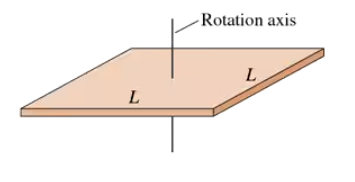
Calculate the moment of inertia of the rectangular plate in FIGURE P12.55 for rotation about a perpendicular axis through the center.

Guida verificata passo dopo passo
1
Step 1: Identify the formula for the moment of inertia of a rectangular plate about an axis perpendicular to its center. The formula is \( I = \frac{1}{12} M (L^2 + L^2) \), where \( M \) is the mass of the plate and \( L \) is the length of each side.
Step 2: Recognize that the plate is square, meaning both sides are equal in length (\( L \)). Substitute \( L \) for both dimensions in the formula.
Step 3: Simplify the formula by combining the terms \( L^2 + L^2 \) into \( 2L^2 \). The formula becomes \( I = \frac{1}{12} M (2L^2) \).
Step 4: Factor out the constant \( 2 \) to further simplify the formula to \( I = \frac{1}{6} M L^2 \).
Step 5: To calculate the moment of inertia, you would need the values of \( M \) (mass of the plate) and \( L \) (length of the sides). Plug these values into the formula \( I = \frac{1}{6} M L^2 \) to find the result.

Risposta video verificata per un problema simile:

Questa soluzione video è stata consigliata dai nostri tutor come utile per risolvere questo problema.

Concetti chiave

Ecco i concetti essenziali che devi comprendere per rispondere correttamente alla domanda.

Moment of Inertia

The moment of inertia is a measure of an object's resistance to rotational motion about a specific axis. It depends on the mass distribution relative to the axis of rotation. For a rectangular plate, the moment of inertia can be calculated using the formula I = (1/12) * m * (L^2 + L^2), where m is the mass and L is the length of the sides.
Video consigliato:
Percorso guidato
11:47
Intro to Moment of Inertia

Axis of Rotation

The axis of rotation is an imaginary line around which an object rotates. In this case, the axis is perpendicular to the plane of the rectangular plate and passes through its center. The choice of the axis significantly affects the moment of inertia, as it determines how the mass is distributed relative to that axis.
Video consigliato:
Percorso guidato
13:46
Parallel Axis Theorem

Mass Distribution

Mass distribution refers to how mass is spread out in an object. For calculating the moment of inertia, it is crucial to know how the mass is arranged in relation to the axis of rotation. In a rectangular plate, the uniform distribution of mass affects the calculations, as each infinitesimal mass element contributes differently to the overall moment of inertia.
Video consigliato:
Percorso guidato
03:42
Moment of Inertia & Mass Distribution
Pratica correlata
Domanda del libro di testo

A small 300 g ball and a small 600 g ball are connected by a 40-cm-long, 200 g rigid rod. b. What is the rotational kinetic energy if the structure rotates about its center of mass at 100 rpm?

1204
views

Domanda del libro di testo

A person's center of mass is easily found by having the person lie on a reaction board. A horizontal, 2.5-m-long, 6.1 kg reaction board is supported only at the ends, with one end resting on a scale and the other on a pivot. A 60 kg woman lies on the reaction board with her feet over the pivot. The scale reads 25 kg. What is the distance from the woman's feet to her center of mass?

1824
views
Domanda del libro di testo

A 4.0-cm-diameter disk with a 3.0-cm-diameter hole rolls down a 50-cm-long, 20° ramp. What is its speed at the bottom? What percent is this of the speed of a particle sliding down a frictionless ramp?

1801
views
1
rank
Domanda del libro di testo

Calculate by direct integration the moment of inertia for a thin rod of mass M and length L about an axis located distance d from one end. Confirm that your answer agrees with Table 12.2 when d=0 and when d = L/2.

321
views
Domanda del libro di testo

Determine the moment of inertia about the axis of the object shown in FIGURE P12.52.

2284
views
Domanda del libro di testo

A 3.0-m-long ladder, as shown in Figure 12.35, leans against a frictionless wall. The coefficient of static friction between the ladder and the floor is 0.40. What is the minimum angle the ladder can make with the floor without slipping?

2586
views