
Ch 12: Rotation of a Rigid Body
Knight Calc - Physics for Scientists and Engineers 5th Edition
Knight Calc5th EditionPhysics for Scientists and EngineersISBN: 9780137344796Non è quello che usi tu?Cambia libro di testo
Capitolo 12, Problema 91b

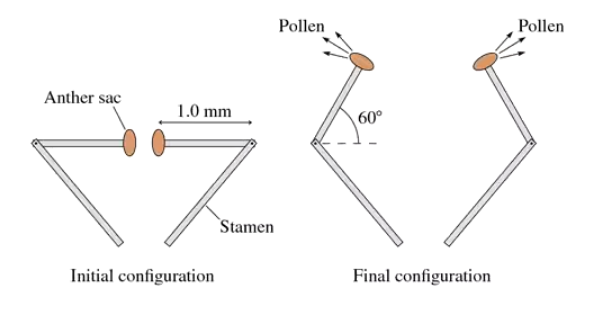
The bunchberry flower has the fastest-moving parts ever observed in a plant. Initially, the stamens are held by the petals in a bent position, storing elastic energy like a coiled spring. When the petals release, the tips of the stamen act like medieval catapults, flipping through a 60° angle in just 0.30 ms to launch pollen from anther sacs at their ends. The human eye just sees a burst of pollen; only high-speed photography reveals the details. As FIGURE CP12.91 shows, we can model the stamen tip as a 1.0-mm-long, 10 μg rigid rod with a 10 μg anther sac at the end. Although oversimplifying, we'll assume a constant angular acceleration. What is the speed of the anther sac as it releases its pollen?

Guida verificata passo dopo passo
1
Step 1: Identify the given values and the target variable. The problem provides the angular displacement (θ = 60° = π/3 radians), the time interval (Δt = 0.30 ms = 0.0003 s), and the mass and length of the stamen tip and anther sac. The goal is to find the linear speed of the anther sac at the moment of release.
Step 2: Relate angular acceleration to angular displacement and time. Use the kinematic equation for rotational motion: θ=12αt2, where θ is the angular displacement, α is the angular acceleration, and t is the time. Rearrange to solve for α: α=2θt2.
Step 3: Calculate the angular velocity at the moment of release using the angular acceleration. Use the equation ω=αt, where ω is the angular velocity, α is the angular acceleration, and t is the time.
Step 4: Relate the linear speed of the anther sac to its angular velocity. The linear speed v is given by v=ωr, where r is the distance from the axis of rotation to the anther sac (1.0 mm = 0.001 m).
Step 5: Substitute the values for ω and r into the equation for v to find the linear speed of the anther sac. Ensure all units are consistent (e.g., radians for angular measurements, seconds for time, meters for length).

Risposta video verificata per un problema simile:

Questa soluzione video è stata consigliata dai nostri tutor come utile per risolvere questo problema.
Durata del video:
6m

Concetti chiave

Ecco i concetti essenziali che devi comprendere per rispondere correttamente alla domanda.

Angular Motion

Angular motion refers to the rotation of an object around an axis. In this context, the stamen tips of the bunchberry flower rotate through a specific angle, which can be analyzed using angular kinematics. Understanding angular motion is crucial for determining the relationship between angular displacement, angular acceleration, and the resulting linear speed of the anther sac as it moves.
Video consigliato:
Percorso guidato
07:06
Angular Momentum of Objects in Linear Motion

Elastic Potential Energy

Elastic potential energy is the energy stored in an object when it is deformed, such as when the stamens are bent by the petals. This energy is released when the petals open, allowing the stamen tips to rapidly accelerate. The conversion of elastic potential energy into kinetic energy is fundamental to understanding how the stamen tips achieve their high speeds during pollen release.
Video consigliato:
Percorso guidato
07:24
Potential Energy Graphs

Kinematics of Rigid Bodies

Kinematics of rigid bodies involves the study of the motion of solid objects without considering the forces that cause the motion. In this scenario, we can model the stamen tip as a rigid rod undergoing angular acceleration. By applying kinematic equations for rotational motion, we can calculate the final linear speed of the anther sac as it is propelled by the rapid movement of the stamen tip.
Video consigliato:
Percorso guidato
08:42
Free-Body Diagrams