Ch 12: Rotation of a Rigid Body
Knight Calc - Physics for Scientists and Engineers 5th Edition
Knight Calc5th EditionPhysics for Scientists and EngineersISBN: 9780137344796Non è quello che usi tu?Cambia libro di testo
Capitolo 12, Problema 15a

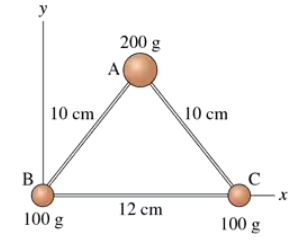
The three masses shown in FIGURE EX12.15 are connected by massless, rigid rods. Find the coordinates of the center of mass.

Guida verificata passo dopo passo
1
Step 1: Understand the problem. The goal is to find the coordinates of the center of mass for the system of four masses connected by massless, rigid rods. The center of mass is calculated using the weighted average of the positions of the masses.
Step 2: Assign coordinates to each mass based on the diagram. For example: A (0, 0), B (12 cm, 0), C (12 cm, 6 cm), and D (0, 6 cm). These coordinates are derived from the given distances in the diagram.
Step 3: Use the formula for the x-coordinate of the center of mass: \( x_{\text{cm}} = \frac{\sum m_i x_i}{\sum m_i} \), where \( m_i \) is the mass of each object and \( x_i \) is its x-coordinate. Substitute the values: \( x_{\text{cm}} = \frac{(200 \times 0) + (400 \times 12) + (100 \times 12) + (400 \times 0)}{200 + 400 + 100 + 400} \).
Step 4: Use the formula for the y-coordinate of the center of mass: \( y_{\text{cm}} = \frac{\sum m_i y_i}{\sum m_i} \), where \( m_i \) is the mass of each object and \( y_i \) is its y-coordinate. Substitute the values: \( y_{\text{cm}} = \frac{(200 \times 0) + (400 \times 0) + (100 \times 6) + (400 \times 6)}{200 + 400 + 100 + 400} \).
Step 5: Simplify both expressions for \( x_{\text{cm}} \) and \( y_{\text{cm}} \) to find the coordinates of the center of mass. The final coordinates will be \( (x_{\text{cm}}, y_{\text{cm}}) \).

Risposta video verificata per un problema simile:

Questa soluzione video è stata consigliata dai nostri tutor come utile per risolvere questo problema.
Durata del video:
9m

Concetti chiave

Ecco i concetti essenziali che devi comprendere per rispondere correttamente alla domanda.

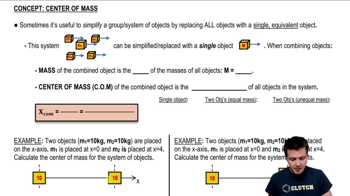
Center of Mass

The center of mass of a system is the point where the total mass of the system can be considered to be concentrated. It is calculated by taking the weighted average of the positions of all masses in the system, factoring in their respective masses. The coordinates of the center of mass can be found using the formula: x_cm = (Σ(m_i * x_i)) / Σm_i and y_cm = (Σ(m_i * y_i)) / Σm_i, where m_i is the mass and (x_i, y_i) are the coordinates of each mass.
Video consigliato:
Percorso guidato
06:30
Intro to Center of Mass

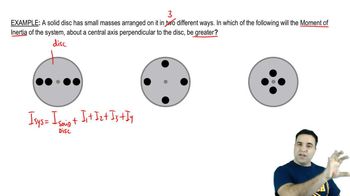
Mass Distribution

Mass distribution refers to how mass is spread out in a system. In this problem, the masses are located at specific points (A, B, C, D) with given weights. Understanding how these masses are arranged in relation to each other is crucial for calculating the center of mass, as it directly influences the resulting coordinates based on their distances and magnitudes.
Video consigliato:
Percorso guidato
03:42
Moment of Inertia & Mass Distribution

Coordinate System

A coordinate system provides a framework for locating points in space using numerical values. In this problem, a two-dimensional Cartesian coordinate system is used, where positions are defined by x (horizontal) and y (vertical) coordinates. This system is essential for determining the positions of the masses and subsequently calculating the center of mass by applying the appropriate formulas.
Video consigliato:
Percorso guidato
05:17
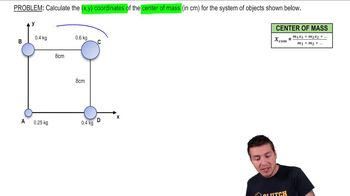
Coordinates of Center of Mass of 4 objects