Ch 13: Newton's Theory of Gravity
Knight Calc - Physics for Scientists and Engineers 5th Edition
Knight Calc5th EditionPhysics for Scientists and EngineersISBN: 9780137344796Non è quello che usi tu?Cambia libro di testo
Capitolo 13, Problema 32a

At what height above the earth is the free-fall acceleration 10% of its value at the surface?

Guida verificata passo dopo passo
1
Start by recalling the formula for gravitational acceleration: g = Gm/(r^2), where G is the gravitational constant, m is the mass of the Earth, and r is the distance from the center of the Earth.
Set the free-fall acceleration at the desired height to 10% of the surface acceleration: g_{height} = 0.1g_{surface}. Substitute g_{surface} = Gm/(R^2), where R is the radius of the Earth.
Equate the two expressions for gravitational acceleration: 0.1(Gm/(R^2)) = Gm/(r^2). Cancel out Gm from both sides, leaving 0.1/(R^2) = 1/(r^2).
Rearrange the equation to solve for r: r = R/sqrt(0.1). This gives the distance from the center of the Earth where the free-fall acceleration is 10% of its surface value.
Finally, calculate the height above the Earth's surface by subtracting the Earth's radius from r: height = r - R. This is the required height above the Earth's surface.

Risposta video verificata per un problema simile:

Questa soluzione video è stata consigliata dai nostri tutor come utile per risolvere questo problema.
Durata del video:
6m

Concetti chiave

Ecco i concetti essenziali che devi comprendere per rispondere correttamente alla domanda.

Free-Fall Acceleration

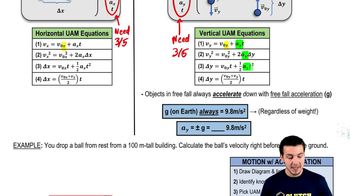
Free-fall acceleration, denoted as 'g', is the acceleration experienced by an object due solely to the force of gravity. At the Earth's surface, this value is approximately 9.81 m/s². As an object moves away from the Earth's surface, this acceleration decreases due to the inverse square law of gravitation.
Video consigliato:
Percorso guidato
08:36
Vertical Motion & Free Fall

Gravitational Force and Distance

The gravitational force between two masses decreases with the square of the distance between their centers. This relationship is described by Newton's law of universal gravitation, which states that the force is inversely proportional to the square of the distance. Therefore, as one moves further from the Earth, the gravitational pull diminishes, affecting the free-fall acceleration.
Video consigliato:
Percorso guidato
05:41
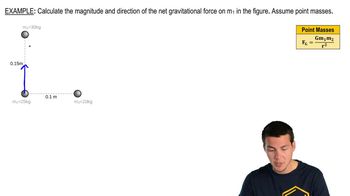
Gravitational Forces in 2D

Height Above Earth's Surface

The height above the Earth's surface is a critical factor in determining the gravitational acceleration experienced by an object. To find the height at which the free-fall acceleration is 10% of its surface value, one must calculate the distance from the center of the Earth where this condition holds true, using the relationship between gravitational force and distance.
Video consigliato:
Percorso guidato
9:26
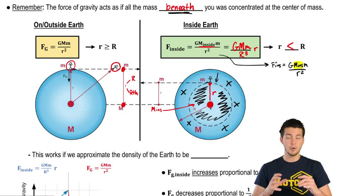
Gravitational Force Inside the Earth
Pratica correlata
Domanda del libro di testo

What is the total gravitational potential energy of the three masses in FIGURE P13.35?

1886
views

Domanda del libro di testo

A new planet is discovered orbiting the star Vega in a circular orbit. The planet takes 55 earth years to complete one orbit around the star. Vega's mass is 2.1 times the sun's mass. What is the radius of the planet's orbit? Give your answer as a multiple of the radius of the earth's orbit.

2043
views
Domanda del libro di testo

What is the net gravitational force on the 20.0 kg mass in FIGURE P13.36? Give your answer using unit vectors.

1991
views
Domanda del libro di testo

The Parker Solar Probe, launched in 2018, was the first spacecraft to explore the solar corona, the hot gases and flares that extend outward from the solar surface. The probe is in a highly elliptical orbit that, using the gravity of Venus, will be nudged ever closer to the sun until, in 2025, it reaches a closest approach of 6.9 million kilometers from the center of the sun. Its maximum speed as it whips through the corona will be 192 km/s. The probe's highly elliptical orbit carries it out to a maximum distance of 160 Rs with a period of 88 days. What is its slowest speed, in km/s?

1984
views
Domanda del libro di testo

What is the total gravitational potential energy of the three masses in FIGURE P13.36?

1116
views
Domanda del libro di testo

A small moon orbits its planet in a circular orbit at a speed of 7.5 km/s. It takes 28 hours to complete one full orbit. What is the mass of the planet?

1698
views