Ch 13: Newton's Theory of Gravity
Knight Calc - Physics for Scientists and Engineers 5th Edition
Knight Calc5th EditionPhysics for Scientists and EngineersISBN: 9780137344796Non è quello che usi tu?Cambia libro di testo
Capitolo 13, Problema 14

Suppose we could shrink the earth without changing its mass. At what fraction of its current radius would the free-fall acceleration at the surface be three times its present value?

Guida verificata passo dopo passo
1
Start by recalling the formula for gravitational acceleration at the surface of a planet: g = (GM)R2, where G is the gravitational constant, M is the mass of the Earth, and R is the radius of the Earth.
Since the problem states that the free-fall acceleration becomes three times its current value, let the new acceleration be g' = 3g. Substitute this into the formula for gravitational acceleration: g' = (GM)R'2, where R' is the new radius.
Divide the equation for g' by the equation for g to eliminate G and M: g'g = R2R'2. Substitute g' = 3g into this equation.
Simplify the equation: 3 = R2R'2. Take the square root of both sides to solve for the ratio of the radii: 3 = RR'.
Rearrange the equation to find the fraction of the current radius: R' = R3. This gives the new radius as a fraction of the current radius.

Risposta video verificata per un problema simile:

Questa soluzione video è stata consigliata dai nostri tutor come utile per risolvere questo problema.
Durata del video:
7m

Concetti chiave

Ecco i concetti essenziali che devi comprendere per rispondere correttamente alla domanda.

Gravitational Acceleration

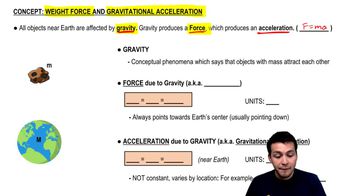
Gravitational acceleration is the acceleration experienced by an object due to the gravitational force exerted by a massive body, such as Earth. It is denoted by 'g' and has a standard value of approximately 9.81 m/s² at Earth's surface. This acceleration depends on the mass of the Earth and the distance from its center, following the formula g = G * M / r², where G is the gravitational constant, M is the mass of the Earth, and r is the radius.
Video consigliato:
Percorso guidato
07:32
Weight Force & Gravitational Acceleration

Inverse Square Law

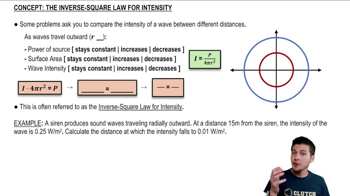
The inverse square law states that the strength of a physical quantity (like gravitational force) decreases with the square of the distance from the source. In the context of gravity, if the radius of a planet is reduced while keeping its mass constant, the gravitational acceleration at the surface increases because the distance to the center of mass decreases, leading to a stronger gravitational pull.
Video consigliato:
Percorso guidato
05:26
The Inverse-Square Law for Intensity

Scaling Relationships

Scaling relationships in physics refer to how physical quantities change when the size of an object is altered. In this scenario, if the radius of the Earth is reduced to a fraction of its original size, the gravitational acceleration will increase according to the inverse square of the radius. Understanding these relationships allows us to calculate how changes in size affect gravitational forces and accelerations.
Video consigliato:
Percorso guidato
03:43
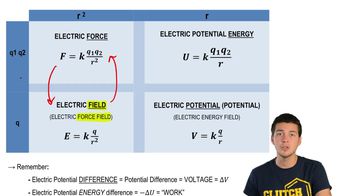
Relationships Between Force, Field, Energy, Potential