
Ch 13: Newton's Theory of Gravity
Knight Calc - Physics for Scientists and Engineers 5th Edition
Knight Calc5th EditionPhysics for Scientists and EngineersISBN: 9780137344796Non è quello che usi tu?Cambia libro di testo
Capitolo 13, Problema 19

Two stars, one twice as massive as the other, are 1.0 light year (ly) apart. One light year is the distance light travels in one year at the speed of light, 3.00 ✕ 108 m/s . The gravitational potential energy of this double-star system is - 8.0 ✕ 1034 J. What is the mass of the lighter star?

Guida verificata passo dopo passo
1
Step 1: Recall the formula for gravitational potential energy between two masses: U = -(Gm1m2)r, where U is the gravitational potential energy, G is the gravitational constant (6.674 × 10⁻¹¹ m3kg-1s-2), m1 and m2 are the masses of the two stars, and r is the distance between them.
Step 2: Let the mass of the lighter star be m. Since the other star is twice as massive, its mass is 2m. Substitute these into the formula for gravitational potential energy: U = -(Gm⋅2m)r.
Step 3: Simplify the expression for gravitational potential energy: U = -(2Gm2)r. Substitute the given values: U = -8.0 × 1034 J, r = 1.0 ly (convert to meters: 1.0 ly = 9.461 × 10¹⁵ m), and G = 6.674 × 10⁻¹¹.
Step 4: Rearrange the formula to solve for m: m2 = -U⋅r2G. Take the square root to find m: m = (-U⋅r)2G.
Step 5: Substitute the known values into the rearranged formula to calculate m. Ensure all units are consistent (e.g., meters, kilograms, seconds) before performing the calculation.

Risposta video verificata per un problema simile:

Questa soluzione video è stata consigliata dai nostri tutor come utile per risolvere questo problema.
Durata del video:
6m

Concetti chiave

Ecco i concetti essenziali che devi comprendere per rispondere correttamente alla domanda.

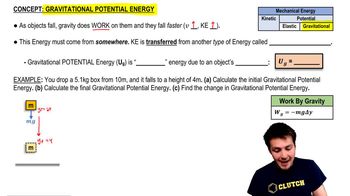
Gravitational Potential Energy

Gravitational potential energy (U) in a two-body system is the energy associated with the gravitational interaction between the two masses. It is given by the formula U = -G(m1*m2)/r, where G is the gravitational constant, m1 and m2 are the masses of the two objects, and r is the distance between their centers. A negative value indicates that the gravitational force is attractive, and the energy decreases as the objects come closer.
Video consigliato:
Percorso guidato
06:35
Gravitational Potential Energy

Mass and Distance Relationship

In gravitational interactions, the force and potential energy depend on the masses of the objects and the distance between them. For two stars, if one star is twice as massive as the other, the gravitational potential energy will reflect this ratio. Understanding how mass influences gravitational potential energy is crucial for solving problems involving multiple bodies in space.
Video consigliato:
Percorso guidato
07:45
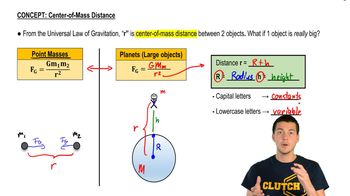
Center of Mass Distance

Units of Measurement in Astronomy

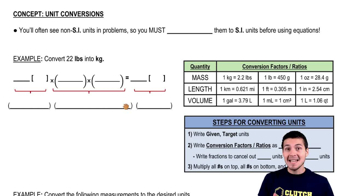
In astronomy, distances are often measured in light years (ly), which is the distance light travels in one year, approximately 9.46 trillion kilometers. This unit is essential for understanding the vast distances between celestial objects. Additionally, energy is measured in joules (J), and recognizing the conversion between these units is important for calculations involving gravitational potential energy in astrophysical contexts.
Video consigliato:
Percorso guidato
07:46
Unit Conversions
Pratica correlata
Domanda del libro di testo

You have been visiting a distant planet. Your measurements have determined that the planet's mass is twice that of earth but the free-fall acceleration at the surface is only one-fourth as large. What is the planet's radius?

1367
views
Domanda del libro di testo

A rocket is launched straight up from the earth's surface at a speed of 15,000 m/s. What is its speed when it is very far away from the earth?

2583
views
1
comments
Domanda del libro di testo

A space station orbits the sun at the same distance as the earth but on the opposite side of the sun. A small probe is fired away from the station. What minimum speed does the probe need to escape the solar system?

1701
views
Domanda del libro di testo

Nothing can escape the event horizon of a black hole, not even light. You can think of the event horizon as being the distance from a black hole at which the escape speed is the speed of light, 3.00 ✕ 10⁸ m/s, making all escape impossible. What is the radius of the event horizon for a black hole with a mass 5.0 times the mass of the sun? This distance is called the Schwarzschild radius.

3007
views
Domanda del libro di testo

You have been visiting a distant planet. Your measurements have determined that the planet's mass is twice that of earth but the free-fall acceleration at the surface is only one-fourth as large. To get back to earth, you need to escape the planet. What minimum speed does your rocket need?

1537
views
Domanda del libro di testo

What is the escape speed from Jupiter?

2404
views