
Ch 14: Fluids and Elasticity
Knight Calc - Physics for Scientists and Engineers 5th Edition
Knight Calc5th EditionPhysics for Scientists and EngineersISBN: 9780137344796Non è quello che usi tu?Cambia libro di testo
Capitolo 14, Problema 42

A friend asks you how much pressure is in your car tires. You know that the tire manufacturer recommends 30 psi, but it's been a while since you've checked. You can't find a tire gauge in the car, but you do find the owner's manual and a ruler. Fortunately, you've just finished taking physics, so you tell your friend, 'I don't know, but I can figure it out.' From the owner's manual you find that the car's mass is 1500 kg. It seems reasonable to assume that each tire supports one-fourth of the weight. With the ruler you find that the tires are 15 cm wide and the flattened segment of the tire in contact with the road is 13 cm long. What answer—in psi—will you give your friend?

Guida verificata passo dopo passo
1
Step 1: Calculate the total weight of the car using the formula for weight: \( W = m \cdot g \), where \( m \) is the mass of the car (1500 kg) and \( g \) is the acceleration due to gravity (approximately \( 9.8 \, \text{m/s}^2 \)).
Step 2: Determine the weight supported by each tire. Since the car has four tires and the weight is evenly distributed, divide the total weight by 4.
Step 3: Calculate the contact area of one tire with the road. The contact area is a rectangle, so use the formula \( A = \text{width} \cdot \text{length} \), where the width is 15 cm (convert to meters: \( 0.15 \, \text{m} \)) and the length is 13 cm (convert to meters: \( 0.13 \, \text{m} \)).
Step 4: Compute the pressure exerted by one tire using the formula \( P = \frac{F}{A} \), where \( F \) is the weight supported by one tire (from Step 2) and \( A \) is the contact area (from Step 3). Ensure the pressure is in pascals (\( \text{Pa} \)).
Step 5: Convert the pressure from pascals to psi. Use the conversion factor \( 1 \, \text{psi} = 6894.76 \, \text{Pa} \). Divide the pressure in pascals by 6894.76 to express the result in psi.

Risposta video verificata per un problema simile:

Questa soluzione video è stata consigliata dai nostri tutor come utile per risolvere questo problema.
Durata del video:
6m

Concetti chiave

Ecco i concetti essenziali che devi comprendere per rispondere correttamente alla domanda.

Pressure

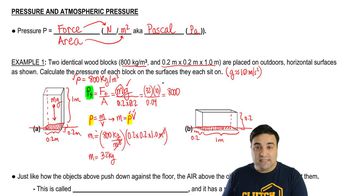
Pressure is defined as the force exerted per unit area. In the context of tires, it is the force that the air inside the tire exerts on the inner walls of the tire, distributed over the contact area with the ground. The standard unit of pressure is pascals (Pa), but in the automotive context, it is often expressed in pounds per square inch (psi). Understanding how to calculate pressure is essential for determining if the tire is inflated to the recommended level.
Video consigliato:
Percorso guidato
17:04
Pressure and Atmospheric Pressure

Force and Weight Distribution

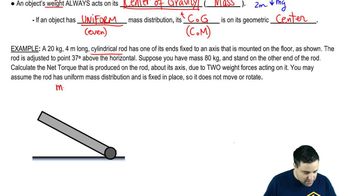
The weight of an object is the force due to gravity acting on it, calculated as the mass multiplied by the acceleration due to gravity (approximately 9.81 m/s²). In this scenario, the total weight of the car is distributed evenly across its four tires, meaning each tire supports one-fourth of the total weight. This distribution is crucial for calculating the force acting on each tire, which is necessary for determining the pressure.
Video consigliato:
Percorso guidato
10:19
Torque Due to Weight

Area of Contact

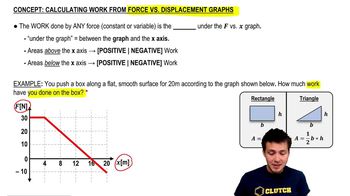
The area of contact refers to the surface area of the tire that is in direct contact with the ground. In this case, it is determined by the width and length of the flattened segment of the tire. The area is critical in calculating pressure, as pressure is inversely proportional to the area over which the force is applied. A smaller contact area results in higher pressure for the same force, while a larger area results in lower pressure.
Video consigliato:
Percorso guidato
04:05
Calculating Work As Area Under F-x Graphs
Pratica correlata
Domanda del libro di testo

A 2.0 mL syringe has an inner diameter of 6.0 mm, a needle inner diameter of 0.25 mm, and a plunger pad diameter (where you place your finger) of 1.2 cm. A nurse uses the syringe to inject medicine into a patient whose blood pressure is 140/100. The nurse empties the syringe in 2.0 s. What is the flow speed of the medicine through the needle?

1890
views
Domanda del libro di testo

A 5.0-m-diameter solid aluminum sphere is launched into space. By how much does its diameter increase? Give your answer in μm.

2075
views
Domanda del libro di testo

Glycerin is poured into an open U-shaped tube until the height in both sides is 20 cm. Ethyl alcohol is then poured into one arm until the height of the alcohol column is 20 cm. The two liquids do not mix. What is the difference in height between the top surface of the glycerin and the top surface of the alcohol?

2893
views
Domanda del libro di testo

An unknown liquid flows smoothly through a 6.0-mm-diameter horizontal tube where the pressure gradient is 600 Pa/m. Then the tube diameter gradually shrinks to 3.0 mm. What is the pressure gradient in this narrower portion of the tube?

1875
views
Domanda del libro di testo

A 55 kg cheerleader uses an oil-filled hydraulic lift to hold four 110 kg football players at a height of 1.0 m. If her piston is 16 cm in diameter, what is the diameter of the football players' piston?

1755
views
1
rank
Domanda del libro di testo

When a second student joins the first, the piston sinks. What is the second student's mass?

1651
views