
A 2.0 mL syringe has an inner diameter of 6.0 mm, a needle inner diameter of 0.25 mm, and a plunger pad diameter (where you place your finger) of 1.2 cm. A nurse uses the syringe to inject medicine into a patient whose blood pressure is 140/100. The nurse empties the syringe in 2.0 s. What is the flow speed of the medicine through the needle?
Ch 14: Fluids and Elasticity
Knight Calc5th EditionPhysics for Scientists and EngineersISBN: 9780137344796Non è quello che usi tu?Cambia libro di testo
Capitolo 14, Problema 23
Styrofoam has a density of 150 kg/m³. What is the maximum mass that can hang without sinking from a 50-cm-diameter Styrofoam sphere in water? Assume the volume of the mass is negligible compared to that of the sphere.
Guida verificata passo dopo passo1
Determine the volume of the Styrofoam sphere using the formula for the volume of a sphere: , where the radius is half the diameter (50 cm = 0.5 m).
Calculate the buoyant force acting on the sphere when it is fully submerged in water using Archimedes' principle: , where is the density of water (1000 kg/m³), is the acceleration due to gravity (9.8 m/s²), and is the volume of the sphere.
Determine the weight of the Styrofoam sphere using the formula , where is the mass of the sphere. The mass can be calculated using , where is the density of Styrofoam (150 kg/m³).
Find the maximum additional mass that can be hung from the sphere without sinking by equating the total weight (weight of the sphere + weight of the additional mass) to the buoyant force. Use the equation: , where is the additional mass.
Solve for the maximum additional mass by rearranging the equation: . Substitute the values for the buoyant force, weight of the sphere, and gravitational acceleration to find the result.

Risposta video verificata per un problema simile:
Questa soluzione video è stata consigliata dai nostri tutor come utile per risolvere questo problema.
Durata del video:
8mConcetti chiave
Ecco i concetti essenziali che devi comprendere per rispondere correttamente alla domanda.
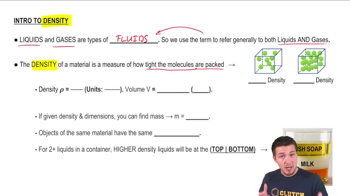
Density
Density is defined as mass per unit volume and is a crucial property of materials. In this context, the density of Styrofoam (150 kg/m³) indicates how much mass is contained in a given volume. Understanding density helps determine how much mass can be supported by the buoyant force when the Styrofoam sphere is submerged in water.
Video consigliato:
Percorso guidato
Intro to Density
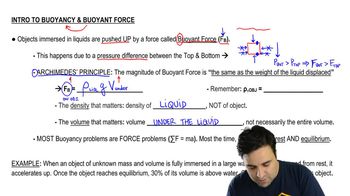
Buoyancy
Buoyancy is the upward force exerted by a fluid that opposes the weight of an object submerged in it. According to Archimedes' principle, the buoyant force on an object is equal to the weight of the fluid displaced by the object. This concept is essential for calculating the maximum mass that can hang from the Styrofoam sphere without sinking, as it determines how much weight the sphere can support.
Video consigliato:
Percorso guidato
Intro to Buoyancy & Buoyant Force
Volume of a Sphere
The volume of a sphere is calculated using the formula V = (4/3)πr³, where r is the radius. For a 50-cm-diameter sphere, the radius is 25 cm (0.25 m). Knowing the volume allows us to calculate the weight of the water displaced by the sphere, which is necessary to find the maximum mass that can be suspended without causing the sphere to sink.
Video consigliato:
Percorso guidato
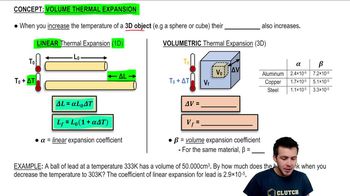
Volume Thermal Expansion
Pratica correlata
Domanda del libro di testo
1890
views
Domanda del libro di testo
A 2.0 cm ✕ 2.0 cm ✕ 6.0 cm block floats in water with its long axis vertical. The length of the block above water is 2.0 cm. What is the block's mass density?
2091
views
Domanda del libro di testo
What is the tension of the string in FIGURE EX14.19?
2264
views
Domanda del libro di testo
What does the top pressure gauge read in FIGURE EX14.28?
2061
views
Domanda del libro di testo
A 6.00-cm-diameter sphere with a mass of 89.3 g is neutrally buoyant in a liquid. Identify the liquid.
1770
views
Domanda del libro di testo
A 2.0 mL syringe has an inner diameter of 6.0 mm, a needle inner diameter of 0.25 mm, and a plunger pad diameter (where you place your finger) of 1.2 cm. A nurse uses the syringe to inject medicine into a patient whose blood pressure is 140/100. What is the minimum force the nurse needs to apply to the syringe?
373
views
