Ch 15: Oscillations
Knight Calc - Physics for Scientists and Engineers 5th Edition
Knight Calc5th EditionPhysics for Scientists and EngineersISBN: 9780137344796Non è quello che usi tu?Cambia libro di testo
Capitolo 15, Problema 18b

A 1.0 kg block is attached to a spring with spring constant 16 N/m. While the block is sitting at rest, a student hits it with a hammer and almost instantaneously gives it a speed of 40 cm/s. What are The block's speed at the point where 𝓍 = (½)A?

Guida verificata passo dopo passo
1
Determine the total mechanical energy of the system. The total energy is the sum of the kinetic energy and the potential energy. At the moment the block is hit, all the energy is kinetic. Use the formula for kinetic energy: \( KE = \frac{1}{2}mv^2 \), where \( m = 1.0 \; \text{kg} \) and \( v = 0.40 \; \text{m/s} \).
Find the amplitude \( A \) of the oscillation. The total mechanical energy \( E \) is also equal to the maximum potential energy stored in the spring, which occurs when the block is at maximum displacement. Use the formula for potential energy in a spring: \( PE = \frac{1}{2}kA^2 \), where \( k = 16 \; \text{N/m} \). Set \( E = \frac{1}{2}kA^2 \) and solve for \( A \).
Determine the displacement \( \frac{1}{2}A \). Since the problem specifies the block's speed at \( \frac{1}{2}A \), calculate this value by dividing the amplitude \( A \) by 2.
Use the conservation of mechanical energy to find the speed at \( \frac{1}{2}A \). The total energy \( E \) is the sum of the kinetic energy \( KE \) and the potential energy \( PE \) at any point. At \( \frac{1}{2}A \), calculate the potential energy using \( PE = \frac{1}{2}k(\frac{1}{2}A)^2 \). Subtract this \( PE \) from the total energy \( E \) to find the kinetic energy \( KE \).
Solve for the speed \( v \) at \( \frac{1}{2}A \) using the formula for kinetic energy: \( KE = \frac{1}{2}mv^2 \). Rearrange to solve for \( v \): \( v = \sqrt{\frac{2KE}{m}} \). Substitute the values of \( KE \) and \( m \) to find the speed.

Risposta video verificata per un problema simile:

Questa soluzione video è stata consigliata dai nostri tutor come utile per risolvere questo problema.
Durata del video:
7m

Concetti chiave

Ecco i concetti essenziali che devi comprendere per rispondere correttamente alla domanda.

Hooke's Law

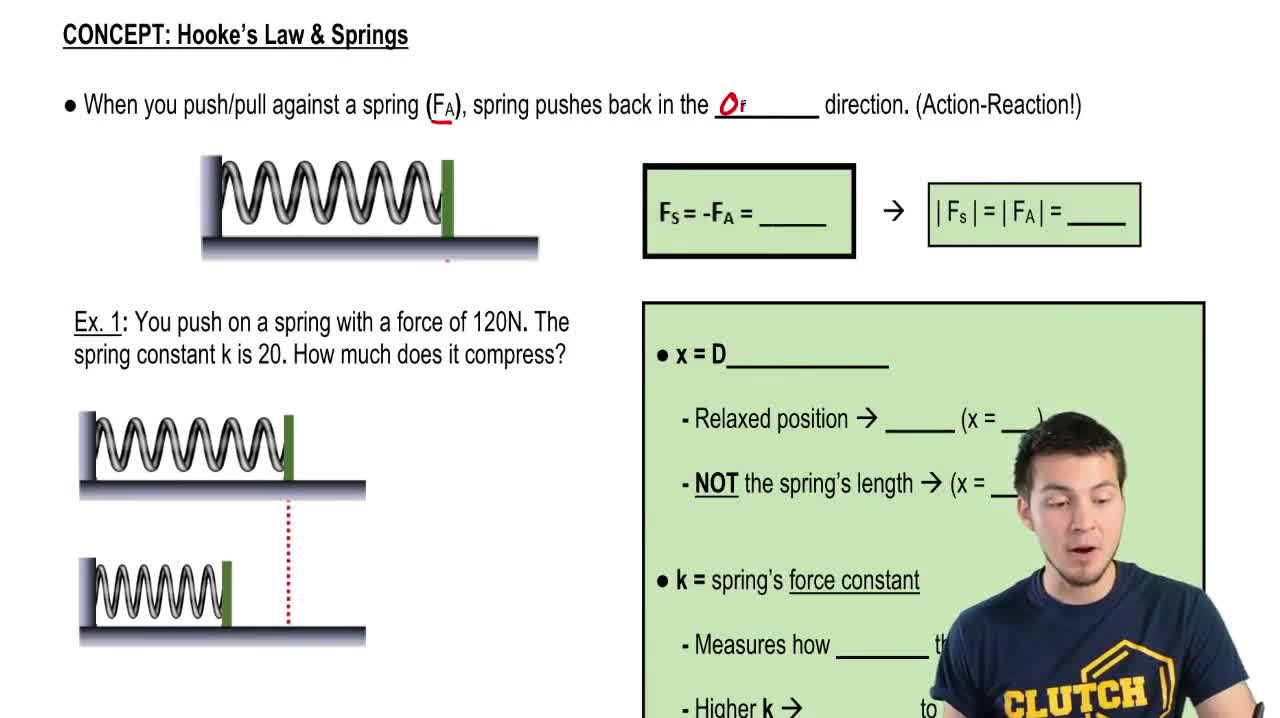
Hooke's Law states that the force exerted by a spring is directly proportional to the displacement from its equilibrium position, expressed as F = -kx, where k is the spring constant and x is the displacement. This principle is essential for understanding how the spring will behave when the block is displaced from its rest position.
Video consigliato:
Percorso guidato
05:27
Spring Force (Hooke's Law)

Conservation of Energy

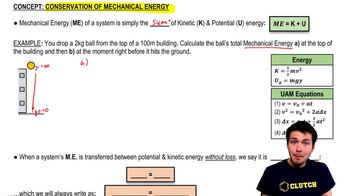
The principle of conservation of energy states that in a closed system, the total energy remains constant. In this scenario, the kinetic energy of the block and the potential energy stored in the spring can be analyzed to determine the block's speed at different points in its motion, particularly when it is at a displacement of ½A.
Video consigliato:
Percorso guidato
06:24
Conservation Of Mechanical Energy

Simple Harmonic Motion (SHM)

Simple Harmonic Motion describes the oscillatory motion of an object when it is displaced from its equilibrium position and is subject to a restoring force proportional to the displacement. In this case, the block's motion can be analyzed as SHM, allowing us to calculate its speed at specific points in the oscillation, such as when it is at ½A.
Video consigliato:
Percorso guidato
07:52
Simple Harmonic Motion of Pendulums