Ch 16: Traveling Waves
Knight Calc - Physics for Scientists and Engineers 5th Edition
Knight Calc5th EditionPhysics for Scientists and EngineersISBN: 9780137344796Non è quello che usi tu?Cambia libro di testo
Capitolo 16, Problema 56c

A wave on a string is described by D(x,t)=(2.00cm)×sin[(12.57rad/m)x−(638rad/s)t]D(x,t) = (2.00 \, \(\text{cm}\)) \(\times\) \(\sin\)[(12.57 \, \(\text{rad/m}\))x - (638 \, \(\text{rad/s}\)) t], where xx is in mm and tt in ss. The linear density of the string is 5.00 g/m5.00\(\text{ g/m}\). What are The maximum speed of a point on the string?

Guida verificata passo dopo passo
1
Step 1: Identify the general equation for the wave on the string, which is given as D(x, t) = (2.00 cm) ✕ sin[(12.57 rad/m)x ─ (638 rad/s)t]. Here, the amplitude of the wave is A = 2.00 cm, the angular frequency is ω = 638 rad/s, and the wave number is k = 12.57 rad/m.
Step 2: Recall that the maximum speed of a point on the string occurs when the displacement D(x, t) is changing most rapidly. This is given by the derivative of D(x, t) with respect to time, which is the velocity of the point on the string: v(x, t) = ∂D(x, t)/∂t.
Step 3: Differentiate D(x, t) with respect to time t. Using the chain rule, ∂D(x, t)/∂t = Aω ✕ cos(kx ─ ωt). The maximum speed occurs when cos(kx ─ ωt) = ±1, which gives the maximum value of the velocity as v_max = Aω.
Step 4: Substitute the values of A and ω into the formula for v_max. Convert the amplitude A from cm to meters: A = 2.00 cm = 0.0200 m. The angular frequency ω is already given as 638 rad/s. Thus, v_max = Aω = (0.0200 m)(638 rad/s).
Step 5: The maximum speed of a point on the string is determined by the product of the amplitude and angular frequency. Perform the multiplication to find the numerical value if needed, but the formula v_max = Aω is the key result.

Risposta video verificata per un problema simile:

Questa soluzione video è stata consigliata dai nostri tutor come utile per risolvere questo problema.
Durata del video:
1m

Concetti chiave

Ecco i concetti essenziali che devi comprendere per rispondere correttamente alla domanda.

Wave Equation

The wave equation describes the behavior of waves, including their amplitude, frequency, and wavelength. In the given equation D(x,t) = (2.00 cm) × sin[(12.57 rad/m)x - (638 rad/s)t], the amplitude is 2.00 cm, the wave number is 12.57 rad/m, and the angular frequency is 638 rad/s. Understanding these parameters is essential for analyzing wave properties and their effects on the medium.
Video consigliato:
Percorso guidato
06:28
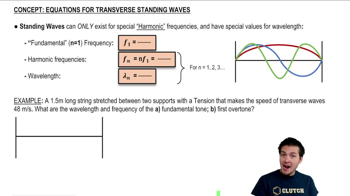
Equations for Transverse Standing Waves

Maximum Speed of a Point on the String

The maximum speed of a point on a wave is determined by the product of the angular frequency and the amplitude of the wave. It can be calculated using the formula v_max = ωA, where ω is the angular frequency and A is the amplitude. This concept is crucial for determining how quickly a point on the string moves as the wave propagates.
Video consigliato:
Percorso guidato
04:39
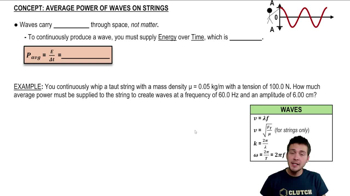
Energy & Power of Waves on Strings

Linear Density

Linear density is defined as the mass per unit length of a string, typically expressed in grams per meter (g/m). In this case, the linear density of the string is 5.00 g/m. This property affects the wave speed and tension in the string, influencing how the wave propagates through the medium and the energy carried by the wave.
Video consigliato:
Percorso guidato
8:13
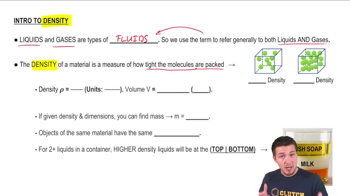
Intro to Density
Pratica correlata
Domanda del libro di testo

FIGURE P16.57 shows a snapshot graph of a wave traveling to the right along a string at 45 m/s. At this instant, what is the velocity of points 1, 2, and 3 on the string?

2092
views

Domanda del libro di testo

One cue your hearing system uses to localize a sound (i.e., to tell where a sound is coming from) is the slight difference in the arrival times of the sound at your ears. Your ears are spaced approximately 20 cm apart. Consider a sound source 5.0 m from the center of your head along a line 45° to your right. What is the difference in arrival times? Give your answer in microseconds. Hint: You are looking for the difference between two numbers that are nearly the same. What does this near equality imply about the necessary precision during intermediate stages of the calculation?

1398
views
Domanda del libro di testo

A 20.0-cm-long, 10.0-cm-diameter cylinder with a piston at one end contains 1.34 kg of an unknown liquid. Using the piston to compress the length of the liquid by 1.00 mm increases the pressure by 41.0 atm. What is the speed of sound in the liquid?

1777
views
Domanda del libro di testo

A string that is under 50.0 N of tension has linear density 5.0 g/m. A sinusoidal wave with amplitude 3.0 cm and wavelength 2.0 m travels along the string. What is the maximum speed of a particle on the string?

1687
views
Domanda del libro di testo

The string in FIGURE P16.59 has linear density μ. Find an expression in terms of M, μ, and θ for the speed of waves on the string.

1416
views
Domanda del libro di testo

A sound wave is described by D(y,t)=(0.0200mm)×sin[(8.96rad/m)y+(3140rad/s)t+π/4rad]D(y, t) = (0.0200 \, \(\text{mm}\)) \(\times\) \(\sin\)[(8.96 \, \(\text{rad/m}\))y + (3140 \, \(\text{rad/s}\))t + \(\pi\)/4 \, \(\text{rad}\)], where yy is in mm and tt is in ss. Along which axis is the air oscillating?

1582
views