Ch 16: Traveling Waves
Knight Calc - Physics for Scientists and Engineers 5th Edition
Knight Calc5th EditionPhysics for Scientists and EngineersISBN: 9780137344796Non è quello che usi tu?Cambia libro di testo
Capitolo 16, Problema 16

Show that the displacement D(x,t) = ln(ax + bt), where a and b are constants, is a solution to the wave equation. Then find an expression in terms of a and b for the wave speed.

Guida verificata passo dopo passo
1
Verify if the given displacement function satisfies the wave equation. The wave equation in one dimension is given by \(\frac{\partial^2 D}{\partial t^2} = v^2 \frac{\partial^2 D}{\partial x^2}\), where \(v\) is the wave speed.
Calculate the first and second partial derivatives of the displacement function \(D(x,t) = \ln(ax + bt)\) with respect to time \(t\). Use the chain rule for differentiation: \(\frac{\partial D}{\partial t} = \frac{1}{ax + bt} \cdot b\) and then \(\frac{\partial^2 D}{\partial t^2} = \frac{-b^2}{(ax + bt)^2}\).
Calculate the first and second partial derivatives of the displacement function with respect to position \(x\). Similarly, use the chain rule: \(\frac{\partial D}{\partial x} = \frac{1}{ax + bt} \cdot a\) and then \(\frac{\partial^2 D}{\partial x^2} = \frac{-a^2}{(ax + bt)^2}\).
Substitute the second derivatives into the wave equation and simplify. Check if \(\frac{-b^2}{(ax + bt)^2} = v^2 \frac{-a^2}{(ax + bt)^2}\). Simplify to see if the equation holds for some constant \(v\).
Solve for \(v\) in terms of \(a\) and \(b\) by equating the coefficients from the simplified wave equation: \(b^2 = v^2 a^2\). Solve for \(v\) to find the wave speed in terms of \(a\) and \(b\): \(v = \frac{b}{a}\).

Risposta video verificata per un problema simile:

Questa soluzione video è stata consigliata dai nostri tutor come utile per risolvere questo problema.

Concetti chiave

Ecco i concetti essenziali che devi comprendere per rispondere correttamente alla domanda.

Wave Equation

The wave equation is a second-order partial differential equation that describes the propagation of waves, such as sound or light, in a medium. It is typically expressed as ∂²D/∂t² = v² ∂²D/∂x², where D is the displacement, t is time, x is position, and v is the wave speed. Understanding this equation is crucial for analyzing how disturbances travel through space and time.
Video consigliato:
Percorso guidato
06:28
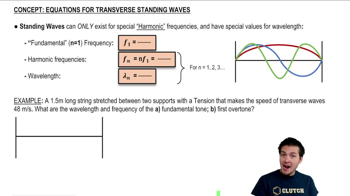
Equations for Transverse Standing Waves

Displacement Function

In the context of wave motion, the displacement function D(x,t) represents the position of a point in the medium at a given time t and position x. The form D(x,t) = ln(ax + bt) indicates a logarithmic relationship between displacement and the linear combination of position and time, which must be verified against the wave equation to confirm it as a valid solution.
Video consigliato:
Percorso guidato
08:30
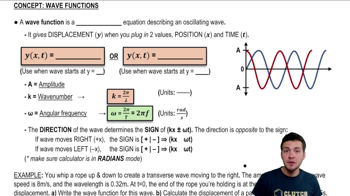
Intro to Wave Functions

Wave Speed

Wave speed is the rate at which a wave propagates through a medium and is denoted by v in the wave equation. It can be derived from the relationship between the second derivatives of the displacement function with respect to time and position. In this case, finding an expression for wave speed in terms of constants a and b involves differentiating the displacement function and applying the wave equation.
Video consigliato:
Percorso guidato
07:19
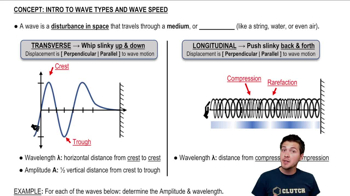
Intro to Waves and Wave Speed