Ch 16: Traveling Waves
Knight Calc - Physics for Scientists and Engineers 5th Edition
Knight Calc5th EditionPhysics for Scientists and EngineersISBN: 9780137344796Non è quello che usi tu?Cambia libro di testo
Capitolo 16, Problema 27

What is the speed of sound in air (a) on a cold winter day in Minnesota when the temperature is -25°F, and (b) on a hot summer day in Death Valley when the temperature is 125°F?

Guida verificata passo dopo passo
1
Step 1: Convert the given temperatures from Fahrenheit to Celsius using the formula: \( T_{C} = \frac{5}{9}(T_{F} - 32) \). For part (a), substitute \( T_{F} = -25 \) into the formula. For part (b), substitute \( T_{F} = 125 \) into the formula.
Step 2: Use the formula for the speed of sound in air: \( v = 331.4 + 0.6 \cdot T_{C} \), where \( T_{C} \) is the temperature in Celsius. Substitute the converted temperatures from Step 1 into this formula for both cases.
Step 3: Simplify the expression for \( v \) for each case by performing the arithmetic operations. This will give the speed of sound in air for the cold winter day and the hot summer day.
Step 4: Ensure the units of the final speed are in meters per second (m/s), as the formula \( v = 331.4 + 0.6 \cdot T_{C} \) inherently provides the speed in m/s.
Step 5: Interpret the results conceptually: The speed of sound increases with temperature because warmer air molecules move faster, facilitating quicker propagation of sound waves.

Risposta video verificata per un problema simile:

Questa soluzione video è stata consigliata dai nostri tutor come utile per risolvere questo problema.
Durata del video:
5m

Concetti chiave

Ecco i concetti essenziali che devi comprendere per rispondere correttamente alla domanda.

Speed of Sound

The speed of sound is the distance that sound waves travel through a medium in a given amount of time. In air, this speed is influenced by factors such as temperature, humidity, and pressure. Generally, sound travels faster in warmer air because the molecules are more energetic and can transmit the sound waves more quickly.
Video consigliato:
Percorso guidato
05:17
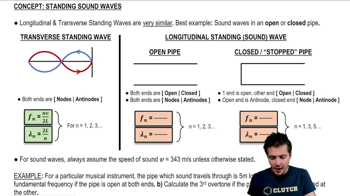
Standing Sound Waves

Effect of Temperature on Sound Speed

Temperature significantly affects the speed of sound in air. As temperature increases, the speed of sound also increases due to the greater kinetic energy of air molecules, which facilitates faster propagation of sound waves. Conversely, at lower temperatures, the speed of sound decreases as molecular motion slows down.
Video consigliato:
Percorso guidato
07:40
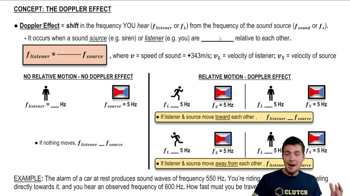
The Doppler Effect

Conversion of Temperature Units

To accurately calculate the speed of sound based on temperature, it is often necessary to convert temperatures from Fahrenheit to Celsius or Kelvin. The formula for conversion from Fahrenheit to Celsius is C = (F - 32) × 5/9. Understanding this conversion is essential for applying the correct temperature values in the speed of sound formula.
Video consigliato:
Percorso guidato
07:46
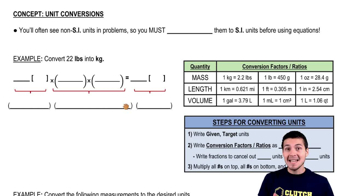
Unit Conversions
Pratica correlata
Domanda del libro di testo

What is the frequency of an electromagnetic wave that has the same wavelength as a 2.5 kHz sound wave in water?

472
views

Domanda del libro di testo

A hammer taps on the end of a 4.00-m-long metal bar at room temperature. A microphone at the other end of the bar picks up two pulses of sound, one that travels through the metal and one that travels through the air. The pulses are separated in time by 9.00 ms. What is the speed of sound in this metal?

1796
views
Domanda del libro di testo

A loudspeaker at the origin emits a 120 Hz tone on a day when the speed of sound is 340 m/s. The phase difference between two points on the x-axis is 5.5 rad. What is the distance between these two points?

439
views
Domanda del libro di testo

A 15-cm-long aluminum tank is filled with ethyl alcohol. A high-frequency ultrasound wave travels horizontally through one wall of the tank and then through the alcohol. There are 275 times more cycles of the wave in the alcohol than in the aluminum wall. How thick is the wall of the tank?

190
views
Domanda del libro di testo

A spherical wave with a wavelength of 2.0 m is emitted from the origin. At one instant of time, the phase at r = 4.0 m is π rad. At that instant, what is the phase at r = 3.5 m and at r = 4.5 m?

380
views
Domanda del libro di testo

A sound source is located somewhere along the x-axis. Experiments show that the same wave front simultaneously reaches listeners at x = -7.0 m and x = +3.0 m. What is the x-coordinate of the source?

1456
views