
Ch 17: Superposition
Knight Calc - Physics for Scientists and Engineers 5th Edition
Knight Calc5th EditionPhysics for Scientists and EngineersISBN: 9780137344796Non è quello che usi tu?Cambia libro di testo
Capitolo 17, Problema 19

A bass clarinet can be modeled as a 120-cm-long open-closed tube. A bass clarinet player starts playing in a 20° C room, but soon the air inside the clarinet warms to where the speed of sound is 352m/s . Does the fundamental frequency increase or decrease? By how much?

Guida verificata passo dopo passo
1
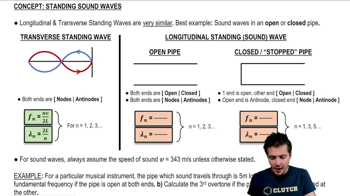
Step 1: Understand the problem. The bass clarinet is modeled as an open-closed tube, meaning it has one open end and one closed end. The fundamental frequency of such a tube is determined by the speed of sound in the air and the length of the tube. The formula for the fundamental frequency is: f=v4L, where v is the speed of sound and L is the length of the tube.
Step 2: Identify the given values. The length of the tube is L=120 cm (convert to meters: L=1.2 m). The speed of sound changes from its value at 20°C (approximately v=343 m/s) to v=352 m/s as the air warms.
Step 3: Analyze the relationship between the speed of sound and the fundamental frequency. Since the fundamental frequency is directly proportional to the speed of sound (f∝v), an increase in the speed of sound will result in an increase in the fundamental frequency.
Step 4: Calculate the initial fundamental frequency using the formula f=v4L. Substitute v=343 m/s and L=1.2 m into the equation.
Step 5: Calculate the new fundamental frequency using the same formula, but with v=352 m/s. Compare the two frequencies to determine the increase in the fundamental frequency. The difference between the two frequencies will give the amount by which the fundamental frequency increases.

Risposta video verificata per un problema simile:

Questa soluzione video è stata consigliata dai nostri tutor come utile per risolvere questo problema.
Durata del video:
3m

Concetti chiave

Ecco i concetti essenziali che devi comprendere per rispondere correttamente alla domanda.

Fundamental Frequency

The fundamental frequency is the lowest frequency at which a system, such as a musical instrument, vibrates. For an open-closed tube like a bass clarinet, the fundamental frequency is determined by the length of the tube and the speed of sound in the medium inside it. It can be calculated using the formula f = v / (4L), where f is the frequency, v is the speed of sound, and L is the length of the tube.
Video consigliato:
Percorso guidato
05:08
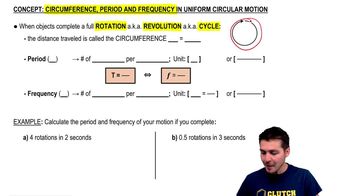
Circumference, Period, and Frequency in UCM

Speed of Sound

The speed of sound is the rate at which sound waves propagate through a medium. In air, this speed is influenced by temperature; as the temperature increases, the speed of sound also increases. In this scenario, the speed of sound in the bass clarinet is given as 352 m/s, which is higher than the typical speed at room temperature, indicating that the air inside the instrument has warmed up.
Video consigliato:
Percorso guidato
05:17
Standing Sound Waves

Effect of Temperature on Frequency

Temperature affects the speed of sound, which in turn influences the frequency of sound produced by musical instruments. As the speed of sound increases due to a rise in temperature, the fundamental frequency of the instrument also increases. Therefore, in this case, as the air inside the bass clarinet warms up, the fundamental frequency will increase, leading to a higher pitch.
Video consigliato:
Percorso guidato
07:40
The Doppler Effect