Ch 17: Superposition
Knight Calc - Physics for Scientists and Engineers 5th Edition
Knight Calc5th EditionPhysics for Scientists and EngineersISBN: 9780137344796Non è quello che usi tu?Cambia libro di testo
Capitolo 17, Problema 9b

Standing waves on a 1.0-m-long string that is fixed at both ends are seen at successive frequencies of 36 Hz and 48 Hz. Draw the standing-wave pattern when the string oscillates at 48 Hz.

Guida verificata passo dopo passo
1
Understand the problem: Standing waves occur when a string fixed at both ends vibrates at specific frequencies called harmonics. The successive frequencies given (36 Hz and 48 Hz) correspond to two consecutive harmonics. The task is to determine the standing-wave pattern for the 48 Hz frequency.
Determine the harmonic numbers: The difference between successive harmonic frequencies is the fundamental frequency (f₁). Calculate the fundamental frequency using the formula: \( f_1 = f_{n+1} - f_n \), where \( f_{n+1} = 48 \ \text{Hz} \) and \( f_n = 36 \ \text{Hz} \).
Identify the harmonic for 48 Hz: Divide the given frequency (48 Hz) by the fundamental frequency \( f_1 \) to find the harmonic number \( n \). Use the formula: \( n = \frac{f}{f_1} \).
Draw the standing-wave pattern: For a string fixed at both ends, the number of antinodes corresponds to the harmonic number \( n \). Sketch the string with \( n \) antinodes, ensuring that the ends of the string are nodes (points of no displacement).
Label the diagram: Clearly label the nodes (points of no displacement) and antinodes (points of maximum displacement) on the standing-wave pattern. Indicate the frequency (48 Hz) and the length of the string (1.0 m) on the diagram.

Risposta video verificata per un problema simile:

Questa soluzione video è stata consigliata dai nostri tutor come utile per risolvere questo problema.
Durata del video:
2m

Concetti chiave

Ecco i concetti essenziali che devi comprendere per rispondere correttamente alla domanda.

Standing Waves

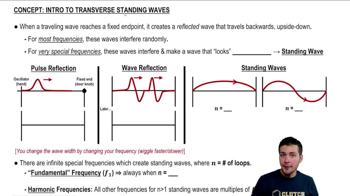
Standing waves are formed when two waves of the same frequency and amplitude travel in opposite directions and interfere with each other. This results in a pattern of nodes, where there is no movement, and antinodes, where the maximum displacement occurs. In a fixed string, standing waves can only form at specific frequencies, known as the harmonic frequencies.
Video consigliato:
Percorso guidato
07:58
Intro to Transverse Standing Waves

Harmonics

Harmonics are the integer multiples of a fundamental frequency at which standing waves can exist on a string. For a string fixed at both ends, the fundamental frequency (first harmonic) corresponds to one antinode in the center and two nodes at the ends. Higher harmonics have more nodes and antinodes, with the second harmonic having two antinodes and three nodes, and so on.
Video consigliato:
Percorso guidato
07:52
Simple Harmonic Motion of Pendulums

Frequency and Wavelength Relationship

The frequency of a wave is inversely related to its wavelength, as described by the wave equation: v = fλ, where v is the wave speed, f is the frequency, and λ is the wavelength. For a string fixed at both ends, the wavelength of the standing wave is determined by the length of the string and the harmonic being produced. As the frequency increases, the wavelength decreases, leading to more nodes and antinodes in the standing wave pattern.
Video consigliato:
Percorso guidato
05:08
Circumference, Period, and Frequency in UCM