
Ch 17: Superposition
Knight Calc - Physics for Scientists and Engineers 5th Edition
Knight Calc5th EditionPhysics for Scientists and EngineersISBN: 9780137344796Non è quello che usi tu?Cambia libro di testo
Capitolo 17, Problema 31

Two out-of-phase radio antennas at x=±300 m on the x-axis are emitting 3.0 MHz radio waves. Is the point (x, y) =(300 m, 800 m) a point of maximum constructive interference, maximum destructive interference, or something in between?

Guida verificata passo dopo passo
1
Step 1: Calculate the wavelength of the radio waves using the formula \( \lambda = \frac{c}{f} \), where \( c \) is the speed of light (\( 3 \times 10^8 \, \text{m/s} \)) and \( f \) is the frequency (\( 3.0 \times 10^6 \; \text{Hz} \)).
Step 2: Determine the distances from the two antennas to the point \((300 \; \text{m}, 800 \; \text{m})\). Use the distance formula \( d = \sqrt{(x_2 - x_1)^2 + (y_2 - y_1)^2} \) for each antenna. For the antenna at \( x = 300 \; \text{m} \), the distance is \( \sqrt{(300 - 300)^2 + (800 - 0)^2} \). For the antenna at \( x = -300 \; \text{m} \), the distance is \( \sqrt{(300 - (-300))^2 + (800 - 0)^2} \).
Step 3: Find the path difference between the distances calculated in Step 2. The path difference is \( \Delta d = |d_1 - d_2| \), where \( d_1 \) and \( d_2 \) are the distances from the two antennas to the point.
Step 4: Compare the path difference \( \Delta d \) to the wavelength \( \lambda \). If \( \Delta d \) is an integer multiple of \( \lambda \) (\( \Delta d = n \lambda \), where \( n \) is an integer), the point is a location of maximum constructive interference. If \( \Delta d \) is an odd multiple of half the wavelength (\( \Delta d = (2n+1) \frac{\lambda}{2} \)), the point is a location of maximum destructive interference. Otherwise, the interference is somewhere in between.
Step 5: Based on the comparison in Step 4, classify the point \((300 \; \text{m}, 800 \; \text{m})\) as a point of maximum constructive interference, maximum destructive interference, or something in between.

Risposta video verificata per un problema simile:

Questa soluzione video è stata consigliata dai nostri tutor come utile per risolvere questo problema.
Durata del video:
7m

Concetti chiave

Ecco i concetti essenziali che devi comprendere per rispondere correttamente alla domanda.

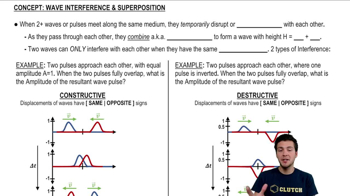
Interference of Waves

Interference occurs when two or more waves overlap, resulting in a new wave pattern. Constructive interference happens when waves are in phase, leading to increased amplitude, while destructive interference occurs when waves are out of phase, resulting in reduced amplitude. The type of interference at a point depends on the relative phase difference between the waves at that location.
Video consigliato:
Percorso guidato
03:47
Wave Interference & Superposition

Path Difference

Path difference refers to the difference in distance traveled by two waves from their sources to a specific point. For constructive interference, the path difference must be an integer multiple of the wavelength, while for destructive interference, it should be a half-integer multiple. Calculating the path difference is essential to determine the interference pattern at a given point.
Video consigliato:

Wavelength and Frequency

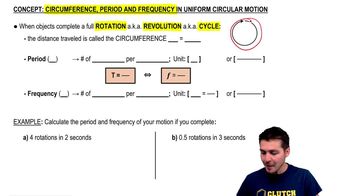
The wavelength is the distance between successive peaks of a wave, and it is inversely related to frequency, which is the number of oscillations per second. For radio waves, the wavelength can be calculated using the speed of light divided by the frequency. Understanding the relationship between wavelength and frequency is crucial for analyzing wave behavior and interference patterns.
Video consigliato:
Percorso guidato
05:08
Circumference, Period, and Frequency in UCM
Pratica correlata
Domanda del libro di testo

Two strings are adjusted to vibrate at exactly 200 Hz. Then the tension in one string is increased slightly. Afterward, three beats per second are heard when the strings vibrate at the same time. What is the new frequency of the string that was tightened?

1616
views
Domanda del libro di testo

FIGURE EX17.27 shows the circular wave fronts emitted by two wave sources. Make a table with rows labeled P, Q, and R and columns labeled r1, r2, Δr, and C/D. Fill in the table for points P, Q, and R, giving the distances as multiples of λ and indicating, with a C or a D, whether the interference at that point is constructive or destructive.

2143
views
Domanda del libro di testo

A 2.0-m-long string vibrates at its second-harmonic frequency with a maximum amplitude of 2.0 cm. One end of the string is at x = 0 cm. Find the oscillation amplitude at x = 10, 20, 30, 40, and 50 cm.

1166
views
Domanda del libro di testo

What is the thinnest film of MgF2 (n=1.39) on glass that produces a strong reflection for orange light with a wavelength of 600 nm?

420
views
Domanda del libro di testo

A flute player hears four beats per second when she compares her note to a 523 Hz tuning fork (the note C). She can match the frequency of the tuning fork by pulling out the 'tuning joint' to lengthen her flute slightly. What was her initial frequency?

1628
views
Domanda del libro di testo

Two loudspeakers in a 20°C room emit 686 Hz sound waves along the x-axis. If the speakers are out of phase, what is the smallest distance between the speakers for which the interference of the sound waves is maximum constructive?

1824
views