Ch 18: A Macroscopic Description of Matter
Knight Calc - Physics for Scientists and Engineers 5th Edition
Knight Calc5th EditionPhysics for Scientists and EngineersISBN: 9780137344796Non è quello che usi tu?Cambia libro di testo
Capitolo 18, Problema 13b

A demented scientist creates a new temperature scale, the 'Z scale.' He decides to call the boiling point of nitrogen 0°Z and the melting point of iron 1000°Z. Convert 500°Z to degrees Celsius and to kelvins.

Guida verificata passo dopo passo
1
Define the relationship between the Z scale and the Celsius scale. The boiling point of nitrogen is 0°Z, which corresponds to -196°C, and the melting point of iron is 1000°Z, which corresponds to 1538°C. This gives two points to establish a linear relationship between the Z scale and the Celsius scale.
Use the formula for a linear relationship: \( T_{Z} = m \cdot T_{C} + b \), where \( m \) is the slope and \( b \) is the intercept. Calculate the slope \( m \) using the two points: \( m = \frac{T_{Z2} - T_{Z1}}{T_{C2} - T_{C1}} = \frac{1000 - 0}{1538 - (-196)} \).
Determine the intercept \( b \) by substituting one of the points (e.g., \( T_{Z1} = 0 \) and \( T_{C1} = -196 \)) into the linear equation: \( 0 = m \cdot (-196) + b \). Solve for \( b \).
Once the relationship between the Z scale and the Celsius scale is established, convert 500°Z to Celsius using the equation \( T_{C} = \frac{T_{Z} - b}{m} \). Substitute \( T_{Z} = 500 \) into the equation to find \( T_{C} \).
To convert from Celsius to kelvins, use the formula \( T_{K} = T_{C} + 273.15 \). Add 273.15 to the Celsius temperature obtained in the previous step to find the temperature in kelvins.

Risposta video verificata per un problema simile:

Questa soluzione video è stata consigliata dai nostri tutor come utile per risolvere questo problema.
Durata del video:
5m

Concetti chiave

Ecco i concetti essenziali che devi comprendere per rispondere correttamente alla domanda.

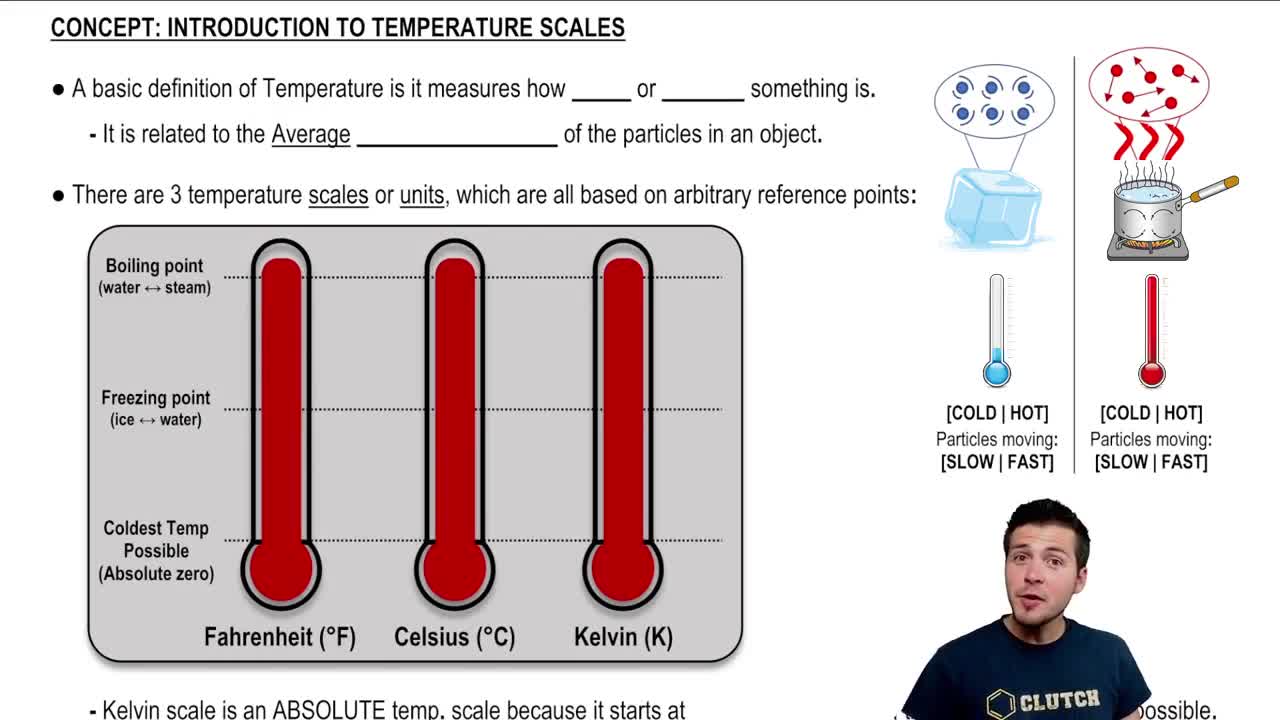
Temperature Scales

Temperature scales, such as Celsius, Kelvin, and the newly defined Z scale, provide a way to quantify thermal energy. Each scale has specific reference points; for instance, 0°C is the freezing point of water, while 100°C is its boiling point. Understanding how to convert between these scales is essential for solving temperature-related problems.
Video consigliato:
Percorso guidato
04:54
Introduction To Temperature Scales

Linear Transformation

Linear transformation is a mathematical concept used to convert values from one scale to another. In the context of temperature conversion, it involves establishing a linear relationship between the two scales based on known reference points. This allows for the calculation of equivalent temperatures in different units.
Video consigliato:

Absolute Zero and Kelvin Scale

The Kelvin scale is an absolute temperature scale starting at absolute zero, the theoretical point where molecular motion ceases. It is crucial for scientific calculations, as it provides a direct measure of thermal energy. The relationship between Celsius and Kelvin is linear, with 0 K equivalent to -273.15°C, which is important for converting temperatures accurately.
Video consigliato:
Percorso guidato
04:54
Introduction To Temperature Scales
Pratica correlata