A container holds 1.0 g of oxygen at a pressure of 8.0 atm. How much will the temperature increase if this amount of heat energy is transferred to the gas at constant volume?
Ch 19: Work, Heat, and the First Law of Thermodynamics
Knight Calc5th EditionPhysics for Scientists and EngineersISBN: 9780137344796Non è quello che usi tu?Cambia libro di testo
Tutti i libri di testo
Knight Calc 5th Edition
Ch 19: Work, Heat, and the First Law of Thermodynamics
Problema 28a
Knight Calc 5th Edition
Ch 19: Work, Heat, and the First Law of Thermodynamics
Problema 28aCapitolo 19, Problema 28a
A container holds 1.0 g of oxygen at a pressure of 8.0 atm. How much heat is required to increase the temperature by 100°C at constant pressure?
Guida verificata passo dopo passo1
Step 1: Identify the relevant formula for heat transfer at constant pressure. The heat required can be calculated using the formula: , where is the heat, is the number of moles, is the molar heat capacity at constant pressure, and is the temperature change.
Step 2: Calculate the number of moles of oxygen gas. Use the molar mass of oxygen, which is approximately 32 g/mol. The number of moles is given by , where is the mass of the gas (1.0 g) and is the molar mass (32 g/mol).
Step 3: Look up the molar heat capacity at constant pressure for oxygen gas. For diatomic gases like oxygen, is approximately 29 J/(mol·K).
Step 4: Determine the temperature change in Kelvin. Since the problem specifies a temperature increase of 100°C, and the size of a degree is the same in Celsius and Kelvin, the temperature change is K.
Step 5: Substitute the values into the formula . Use the calculated number of moles, the molar heat capacity, and the temperature change to find the heat required. Ensure the units are consistent throughout the calculation.

Risposta video verificata per un problema simile:
Questa soluzione video è stata consigliata dai nostri tutor come utile per risolvere questo problema.
Concetti chiave
Ecco i concetti essenziali che devi comprendere per rispondere correttamente alla domanda.
Ideal Gas Law
The Ideal Gas Law relates the pressure, volume, temperature, and number of moles of a gas through the equation PV = nRT. This law is essential for understanding how gases behave under different conditions, particularly when changes in temperature and pressure occur. In this question, it helps to establish the relationship between the gas's properties as heat is added.
Video consigliato:
Percorso guidato
Ideal Gases and the Ideal Gas Law
Specific Heat Capacity
Specific heat capacity is the amount of heat required to raise the temperature of a unit mass of a substance by one degree Celsius. For gases, this value can vary depending on whether the process occurs at constant pressure or volume. In this scenario, the specific heat capacity at constant pressure (Cp) is crucial for calculating the heat required to achieve the desired temperature increase.
Video consigliato:
Percorso guidato
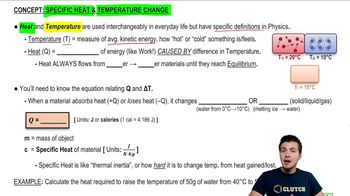
Specific Heat & Temperature Changes
First Law of Thermodynamics
The First Law of Thermodynamics states that energy cannot be created or destroyed, only transformed. In the context of this question, it implies that the heat added to the gas will result in a change in internal energy and work done by the gas, particularly since the process occurs at constant pressure. Understanding this principle is vital for calculating the heat transfer involved in the temperature change.
Video consigliato:
Percorso guidato
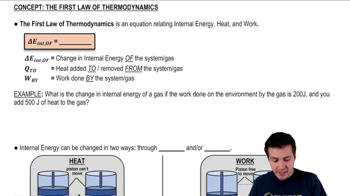
The First Law of Thermodynamics
Pratica correlata
Domanda del libro di testo
195
views
Domanda del libro di testo
A 65 cm3 block of iron is removed from an 800°C furnace and immediately dropped into 200 mL of 20°C water. What fraction of the water boils away?
1595
views
Domanda del libro di testo
A gas cylinder holds 0.10 mol of O₂ at 150°C and a pressure of 3.0 atm. The gas expands adiabatically until the pressure is halved. What are the final volume?
261
views
Domanda del libro di testo
A monatomic gas follows the process 1→2→3 shown in FIGURE EX19.26. How much heat is needed for (a) process 1→2 and (b) process 2→3?
248
views
Domanda del libro di testo
10 g of steam at the boiling point are combined with 50 g of ice at the freezing point. What is the final temperature of the system?
1611
views
Domanda del libro di testo
A gas cylinder holds 0.10 mol of O₂ at 150°C and a pressure of 3.0 atm. The gas expands adiabatically until the pressure is halved. What are the final temperature?
1051
views