Ch 19: Work, Heat, and the First Law of Thermodynamics
Knight Calc - Physics for Scientists and Engineers 5th Edition
Knight Calc5th EditionPhysics for Scientists and EngineersISBN: 9780137344796Non è quello che usi tu?Cambia libro di testo
Capitolo 19, Problema 13

How much heat energy must be added to a 6.0-cm-diameter copper sphere to raise its temperature from −50°C to 150°C?

Guida verificata passo dopo passo
1
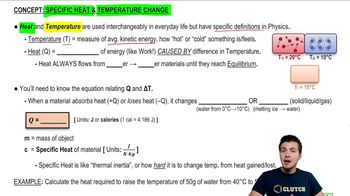
Determine the formula for heat energy required to raise the temperature of an object: Q = mcΔT, where Q is the heat energy, m is the mass of the object, c is the specific heat capacity of the material, and ΔT is the change in temperature.
Calculate the volume of the copper sphere using the formula for the volume of a sphere: V = 43πr3, where r is the radius of the sphere. The radius is half the diameter, so r = 6.02 = 3.0 cm.
Find the mass of the copper sphere using the formula m = ρV, where ρ is the density of copper (approximately 8.96 g/cm³). Substitute the volume calculated in the previous step.
Determine the temperature change ΔT = Tfinal - Tinitial. Here, Tfinal = 150°C and Tinitial = -50°C, so ΔT = 150 - (-50).
Substitute the values for mass, specific heat capacity of copper (approximately 0.385 J/g°C), and temperature change into the heat energy formula Q = mcΔT to calculate the total heat energy required.

Risposta video verificata per un problema simile:

Questa soluzione video è stata consigliata dai nostri tutor come utile per risolvere questo problema.
Durata del video:
4m

Concetti chiave

Ecco i concetti essenziali che devi comprendere per rispondere correttamente alla domanda.

Specific Heat Capacity

Specific heat capacity is the amount of heat energy required to raise the temperature of a unit mass of a substance by one degree Celsius. For copper, this value is approximately 0.385 J/g°C. Understanding this concept is crucial for calculating the heat energy needed to change the temperature of the copper sphere.
Video consigliato:
Percorso guidato
06:50
Specific Heat & Temperature Changes

Heat Energy Calculation

The heat energy (Q) required to change the temperature of an object can be calculated using the formula Q = mcΔT, where m is the mass, c is the specific heat capacity, and ΔT is the change in temperature. This formula allows us to quantify the energy needed based on the material's properties and the desired temperature change.
Video consigliato:
Percorso guidato
07:27
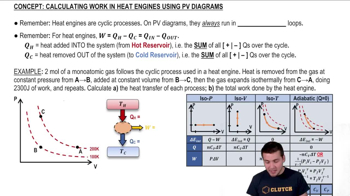
Calculating Work in Heat Engines Using PV Diagrams

Mass of the Sphere

To apply the heat energy calculation, we need to determine the mass of the copper sphere. The mass can be calculated using the formula m = ρV, where ρ is the density of copper (approximately 8.96 g/cm³) and V is the volume of the sphere. The volume of a sphere is given by V = (4/3)πr³, where r is the radius. This step is essential for finding the total heat energy required.
Video consigliato:
Percorso guidato
20:32
Mass Spectrometers
Pratica correlata
Domanda del libro di testo

500 J of heat energy are transferred to a gas during a process in which the gas expands at constant pressure from 400 cm3 to 800 cm3. The gas's thermal energy increases by 300 J during this process. What is the gas pressure?

1662
views
Domanda del libro di testo

What is the maximum mass of ethyl alcohol you could boil with 1000 J of heat, starting from 20°C?

857
views
Domanda del libro di testo

Two cars collide head-on while each is traveling at 80 km/h. Suppose all their kinetic energy is transformed into the thermal energy of the wrecks. What is the temperature increase of each car? You can assume that each car's specific heat is that of iron.

1654
views
Domanda del libro di testo

A rapidly spinning paddle wheel raises the temperature of 200 mL of water from 21°C to 25°C. How much heat is transferred?

1465
views
Domanda del libro di testo

One way you keep from overheating is by perspiring. Evaporation—a phase change—requires heat, and the heat energy is removed from your body. Evaporation is much like boiling, only water's heat of vaporization at 35°C is a somewhat larger 24×105 J/kg because at lower temperatures more energy is required to break the molecular bonds. Very strenuous activity can cause an adult human to produce 30 g of perspiration per minute. If all the perspiration evaporates, rather than dripping off, at what rate (in J/s) is it possible to exhaust heat by perspiring?

104
views
Domanda del libro di testo

Draw a first-law bar chart (see Figure 19.12) for the gas process in FIGURE EX19.7.

441
views