Ch 19: Work, Heat, and the First Law of Thermodynamics
Knight Calc - Physics for Scientists and Engineers 5th Edition
Knight Calc5th EditionPhysics for Scientists and EngineersISBN: 9780137344796Non è quello che usi tu?Cambia libro di testo
Capitolo 19, Problema 56c

n moles of an ideal gas at temperature T1 and volume V1 expand isothermally until the volume has doubled. In terms of n, T1, and V1, what are the heat energy transferred to the gas?

Guida verificata passo dopo passo
1
Step 1: Recognize that the process is isothermal, meaning the temperature (T₁) remains constant throughout the expansion. For an ideal gas undergoing an isothermal process, the internal energy change (ΔU) is zero because internal energy depends only on temperature for an ideal gas.
Step 2: Recall the first law of thermodynamics: ΔU = Q - W, where ΔU is the change in internal energy, Q is the heat energy transferred to the gas, and W is the work done by the gas. Since ΔU = 0 for an isothermal process, we have Q = W.
Step 3: The work done by the gas during an isothermal expansion can be calculated using the formula: W = nRT₁ ln(V₂/V₁), where n is the number of moles, R is the ideal gas constant, T₁ is the constant temperature, and V₂ and V₁ are the final and initial volumes, respectively.
Step 4: Substitute the given condition that the volume doubles, so V₂ = 2V₁. The work done becomes: W = nRT₁ ln(2). Since Q = W, the heat energy transferred to the gas is also Q = nRT₁ ln(2).
Step 5: Conclude that the heat energy transferred to the gas during the isothermal expansion is Q = nRT₁ ln(2). This result is expressed in terms of the given variables n, T₁, and V₁, and does not depend on the specific value of V₁ because it cancels out in the logarithmic ratio.

Risposta video verificata per un problema simile:

Questa soluzione video è stata consigliata dai nostri tutor come utile per risolvere questo problema.
Durata del video:
4m

Concetti chiave

Ecco i concetti essenziali che devi comprendere per rispondere correttamente alla domanda.

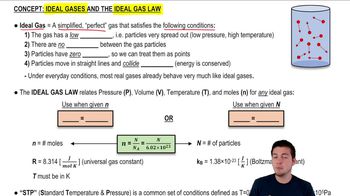
Ideal Gas Law

The Ideal Gas Law relates the pressure, volume, temperature, and number of moles of an ideal gas through the equation PV = nRT. This law is fundamental in understanding the behavior of gases under various conditions, including isothermal processes where temperature remains constant.
Video consigliato:
Percorso guidato
07:21
Ideal Gases and the Ideal Gas Law

Isothermal Process

An isothermal process is a thermodynamic process that occurs at a constant temperature. For an ideal gas, during isothermal expansion, the internal energy remains unchanged, and any work done by the gas is compensated by heat absorbed from the surroundings, which is crucial for calculating heat transfer.
Video consigliato:
Percorso guidato
06:13
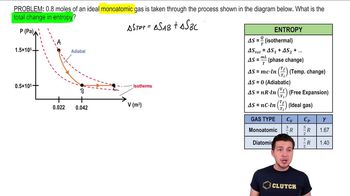
Entropy & Ideal Gas Processes

First Law of Thermodynamics

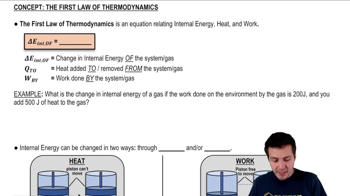
The First Law of Thermodynamics states that the change in internal energy of a system is equal to the heat added to the system minus the work done by the system. In the context of isothermal expansion, this principle helps determine the heat energy transferred to the gas, as the work done during expansion must equal the heat absorbed.
Video consigliato:
Percorso guidato
08:04
The First Law of Thermodynamics