Ch 20: The Micro/Macro Connection
Knight Calc - Physics for Scientists and Engineers 5th Edition
Knight Calc5th EditionPhysics for Scientists and EngineersISBN: 9780137344796Non è quello che usi tu?Cambia libro di testo
Capitolo 20, Problema 60c

2.0 g of helium at an initial temperature of 300 K interacts thermally with 8.0 g of oxygen at an initial temperature of 600 K. How much heat energy is transferred, and in which direction?

Guida verificata passo dopo passo
1
Step 1: Identify the specific heat capacities of helium and oxygen. Helium is a monatomic gas, so its molar specific heat at constant volume is \( C_v = \frac{3}{2}R \), where \( R \) is the universal gas constant. Oxygen is a diatomic gas, so its molar specific heat at constant volume is \( C_v = \frac{5}{2}R \).
Step 2: Calculate the number of moles of helium and oxygen. Use the formula \( n = \frac{m}{M} \), where \( m \) is the mass of the gas and \( M \) is its molar mass. For helium, \( M = 4 \ \text{g/mol} \), and for oxygen, \( M = 32 \ \text{g/mol} \).
Step 3: Determine the heat capacities of helium and oxygen. Multiply the number of moles of each gas by their respective molar specific heat capacities. For helium, \( C_{He} = n_{He} \cdot C_v \), and for oxygen, \( C_{O_2} = n_{O_2} \cdot C_v \).
Step 4: Calculate the final equilibrium temperature \( T_f \) using the principle of conservation of energy. The heat lost by oxygen equals the heat gained by helium: \( C_{O_2} (T_{O_2, \text{initial}} - T_f) = C_{He} (T_f - T_{He, \text{initial}}) \). Solve for \( T_f \).
Step 5: Calculate the heat energy transferred. Use the formula \( Q = C \cdot \Delta T \), where \( \Delta T \) is the temperature change. The direction of heat transfer is from the hotter substance (oxygen) to the cooler substance (helium).

Risposta video verificata per un problema simile:

Questa soluzione video è stata consigliata dai nostri tutor come utile per risolvere questo problema.
Durata del video:
14m

Concetti chiave

Ecco i concetti essenziali che devi comprendere per rispondere correttamente alla domanda.

Heat Transfer

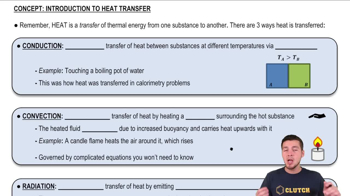
Heat transfer is the process of thermal energy moving from a hotter object to a cooler one until thermal equilibrium is reached. This can occur through conduction, convection, or radiation. In this scenario, heat will flow from the oxygen (hotter) to the helium (cooler) until both gases reach the same temperature.
Video consigliato:
Percorso guidato
05:14
Overview of Heat Transfer

Specific Heat Capacity

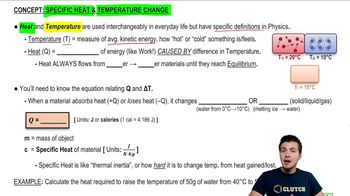
Specific heat capacity is the amount of heat required to raise the temperature of a unit mass of a substance by one degree Celsius. Different substances have different specific heat capacities, which affect how much heat energy is absorbed or released during temperature changes. This concept is crucial for calculating the heat transfer in the given problem.
Video consigliato:
Percorso guidato
06:50
Specific Heat & Temperature Changes

Thermal Equilibrium

Thermal equilibrium occurs when two objects in thermal contact no longer exchange heat, meaning they are at the same temperature. In the context of this problem, the heat transfer will continue until the helium and oxygen reach thermal equilibrium, allowing for the calculation of the total heat energy transferred based on their respective masses and specific heat capacities.
Video consigliato:
Percorso guidato
05:21
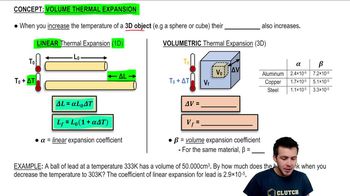
Volume Thermal Expansion
Pratica correlata
Domanda del libro di testo

What is the total rotational kinetic energy of 1.0 mol of nitrogen gas at 300 K?

1451
views

Domanda del libro di testo

A water molecule has its three atoms arranged in a 'V' shape, so it has rotational kinetic energy around any of three mutually perpendicular axes. However, like diatomic molecules, its vibrational modes are not active at temperatures below 1000 K. What is the thermal energy of 2.0 mol of steam at a temperature of 160°C?

1529
views
Domanda del libro di testo

A gas of 1.0 x 10²⁰ atoms or molecules has 1.0 J of thermal energy. Its molar specific heat at constant pressure is 20.8 J/ mol K. What is the temperature of the gas?

1538
views
Domanda del libro di testo

A nitrogen molecule consists of two nitrogen atoms separated by 0.11 nm, the bond length. Treat the molecule as a rotating dumbbell and find the rms angular velocity at this temperature of a nitrogen molecule around the z-axis, as shown in Figure 20.10.

1600
views
Domanda del libro di testo

A 100 cm³ box contains helium at a pressure of 2.0 atm and a temperature of 100℃. It is placed in thermal contact with a 200 cm³ box containing argon at a pressure of 4.0 atm and a temperature of 400℃. What is the final thermal energy of each gas?

1912
views
Domanda del libro di testo

A 100 cm³ box contains helium at a pressure of 2.0 atm and a temperature of 100℃. It is placed in thermal contact with a 200 cm³ box containing argon at a pressure of 4.0 atm and a temperature of 400℃. How much heat energy is transferred, and in which direction?

1397
views