A cylinder contains gas at a pressure of 2.0 atm and a number density of 4.2 x 1025 m-3. The rms speed of the atoms is 660 m/s. Identify the gas.
Guida verificata passo dopo passo
1
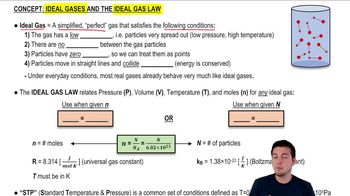
Step 1: Use the ideal gas law in terms of number density to relate pressure, number density, and temperature. The formula is: , where is pressure, is number density, is Boltzmann's constant (), and is temperature.
Step 2: Rearrange the formula to solve for temperature: . Substitute the given values for pressure (, converted to Pascals as ), number density (), and Boltzmann's constant.
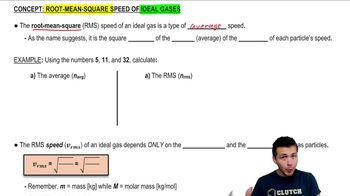
Step 3: Use the formula for the root mean square (rms) speed of gas molecules: , where is the mass of one molecule of the gas. Rearrange the formula to solve for : . Substitute the values for and .
Step 4: Convert the molecular mass to molar mass using Avogadro's number (). The molar mass is given by: , where is Avogadro's number.
Step 5: Compare the calculated molar mass to known molar masses of common gases to identify the gas. For example, if the molar mass is approximately 4 g/mol, the gas is likely helium; if it is approximately 28 g/mol, the gas is likely nitrogen.
Risposta video verificata per un problema simile:
Questa soluzione video è stata consigliata dai nostri tutor come utile per risolvere questo problema.
Durata del video:
7m
Guarda un video:
0 Commenti
Concetti chiave
Ecco i concetti essenziali che devi comprendere per rispondere correttamente alla domanda.
Ideal Gas Law
The Ideal Gas Law relates the pressure, volume, temperature, and number of moles of a gas through the equation PV = nRT. This law is fundamental in understanding the behavior of gases under various conditions and can help identify the type of gas based on its properties.
The root mean square speed is a measure of the average speed of particles in a gas and is given by the formula v_rms = √(3kT/m), where k is the Boltzmann constant, T is the temperature, and m is the mass of a gas particle. This concept is crucial for determining the molecular mass of the gas when combined with other properties.
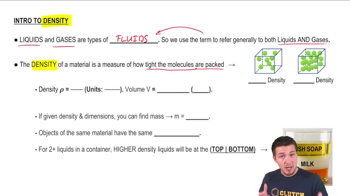
Number density refers to the number of particles per unit volume, typically expressed in particles per cubic meter (m⁻³). It is an important parameter in gas physics, as it helps relate the macroscopic properties of the gas, such as pressure and temperature, to the microscopic behavior of its particles.



 07:21
07:21