Ch 20: The Micro/Macro Connection
Knight Calc - Physics for Scientists and Engineers 5th Edition
Knight Calc5th EditionPhysics for Scientists and EngineersISBN: 9780137344796Non è quello che usi tu?Cambia libro di testo
Capitolo 20, Problema 5

Integrated circuits are manufactured in vacuum chambers in which the air pressure is 1.0 x 10⁻¹⁰ of Hg. What are (a) the number density and (b) the mean free path of a molecule? Assume T = 20℃.

Guida verificata passo dopo passo
1
Convert the given pressure from mmHg to Pascals (Pa) using the conversion factor: 1 mmHg = 133.322 Pa. The pressure in Pascals is given by \( P = (1.0 \times 10^{-10}) \times 133.322 \).
Use the ideal gas law \( PV = nRT \) to find the number density \( n/V \), where \( n/V = P / (RT) \). Here, \( R \) is the universal gas constant (8.314 J/(mol·K)), and \( T \) is the temperature in Kelvin. Convert the temperature from Celsius to Kelvin using \( T(K) = T(°C) + 273.15 \).
Substitute the values of \( P \), \( R \), and \( T \) into the formula \( n/V = P / (RT) \) to calculate the number density of molecules per unit volume.
To calculate the mean free path \( \lambda \), use the formula \( \lambda = \frac{k_B T}{\sqrt{2} \pi d^2 P} \), where \( k_B \) is the Boltzmann constant (1.38 \(\times\) 10^{-23} J/K), \( d \) is the diameter of a molecule (assume a typical value for air molecules, approximately 3.7 \(\times\) 10^{-10} m), and \( P \) is the pressure in Pascals.
Substitute the values of \( k_B \), \( T \), \( d \), and \( P \) into the formula for \( \lambda \) to determine the mean free path of a molecule in the vacuum chamber.

Risposta video verificata per un problema simile:

Questa soluzione video è stata consigliata dai nostri tutor come utile per risolvere questo problema.
Durata del video:
5m

Concetti chiave

Ecco i concetti essenziali che devi comprendere per rispondere correttamente alla domanda.

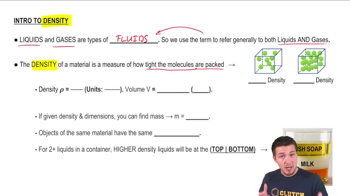
Number Density

Number density refers to the number of particles (molecules, atoms, etc.) per unit volume in a given space. It is typically expressed in units such as particles per cubic meter. In the context of the question, calculating the number density of air molecules at a specific pressure involves using the ideal gas law, which relates pressure, volume, and temperature to the number of particles.
Video consigliato:
Percorso guidato
8:13
Intro to Density

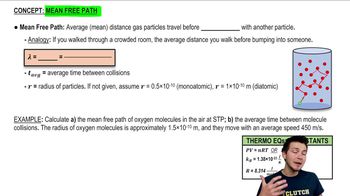
Mean Free Path

The mean free path is the average distance a molecule travels between collisions with other molecules. It is influenced by the number density of the molecules and their effective cross-sectional area for collisions. In low-pressure environments, such as the vacuum chamber mentioned, the mean free path increases significantly, allowing molecules to travel longer distances without colliding.
Video consigliato:

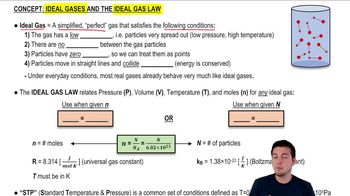
Ideal Gas Law

The ideal gas law is a fundamental equation in thermodynamics that describes the behavior of ideal gases. It is expressed as PV = nRT, where P is pressure, V is volume, n is the number of moles, R is the ideal gas constant, and T is temperature in Kelvin. This law is essential for calculating properties like number density and mean free path, especially when dealing with gases at various pressures and temperatures.
Video consigliato:
Percorso guidato
07:21
Ideal Gases and the Ideal Gas Law
Pratica correlata
Domanda del libro di testo

A cylinder of nitrogen and a cylinder of neon are at the same temperature and pressure. The mean free path of a nitrogen molecule is 150 nm. What is the mean free path of a neon atom?

1703
views

Domanda del libro di testo

The mean free path of a molecule in a gas is 300 nm. What will the mean free path be if the gas temperature is doubled at (a) constant volume and (b) constant pressure?

1830
views
Domanda del libro di testo

The molecules in a six-particle gas have velocities:

v⃗1=(20i^−30j^) m/sv⃗2=(40i^+70j^) m/sv⃗3=(−80i^+20j^) m/sv⃗4=30i^ m/sv⃗5=(40i^−40j^) m/sv⃗6=(−50i^−20j^) m/s \(\begin{aligned}\) \(\vec{v}\)_1 &= (20\(\hat{i}\) - 30\(\hat{j}\)) \(\text{ m/s}\) \\ \(\vec{v}\)_2 &= (40\(\hat{i}\) + 70\(\hat{j}\)) \(\text{ m/s}\) \\ \(\vec{v}\)_3 &= (-80\(\hat{i}\) + 20\(\hat{j}\)) \(\text{ m/s}\) \\ \(\vec{v}\)_4 &= 30\(\hat{i}\) \(\text{ m/s}\) \\ \(\vec{v}\)_5 &= (40\(\hat{i}\) - 40\(\hat{j}\)) \(\text{ m/s}\) \\ \(\vec{v}\)_6 &= (-50\(\hat{i}\) - 20\(\hat{j}\)) \(\text{ m/s}\) \(\end{aligned}\)

Calculate (a) v⃗avg\(\vec{v}\)_{\(\text{avg}\)}, (b) vavgv_{\(\text{avg}\)}, and (c) vrmsv_{\(\text{rms}\)}.

1762
views
Domanda del libro di testo

A 1.0 m ✕ 1.0 m ✕ 1.0 m cube of nitrogen gas is at 20℃ and 1.0 atm. Estimate the number of molecules in the cube with a speed between 700 m/s and 1000 m/s.

1801
views
Domanda del libro di testo

Eleven molecules have speeds 15, 16, 17, …, 25 m/s. Calculate (a) vavg and (b) vrms.

1247
views