Ch 21: Heat Engines and Refrigerators
Knight Calc - Physics for Scientists and Engineers 5th Edition
Knight Calc5th EditionPhysics for Scientists and EngineersISBN: 9780137344796Non è quello che usi tu?Cambia libro di testo
Capitolo 21, Problema 69

100 mL of water at 15℃ is placed in the freezer compartment of a refrigerator with a coefficient of performance of 4.0. How much heat energy is exhausted into the room as the water is changed to ice at -15℃?

Guida verificata passo dopo passo
1
Determine the total heat energy that needs to be removed from the water to change it from liquid at 15℃ to ice at -15℃. This involves three stages: cooling the water to 0℃, freezing the water at 0℃, and cooling the ice to -15℃.
For the first stage, calculate the heat removed to cool the water from 15℃ to 0℃ using the formula: Q=mcΔT, where m is the mass of the water, c is the specific heat capacity of water (4.18 J/g·℃), and ΔT is the temperature change.
For the second stage, calculate the heat removed to freeze the water at 0℃ using the formula: Q=mL, where L is the latent heat of fusion for water (334 J/g).
For the third stage, calculate the heat removed to cool the ice from 0℃ to -15℃ using the formula: Q=mcΔT, where c is the specific heat capacity of ice (2.09 J/g·℃).
Finally, calculate the heat energy exhausted into the room using the coefficient of performance (COP) of the refrigerator. The relationship is: Qout=Qin+W, where W=QinCOP. Combine these to find Qout.

Risposta video verificata per un problema simile:

Questa soluzione video è stata consigliata dai nostri tutor come utile per risolvere questo problema.
Durata del video:
6m

Concetti chiave

Ecco i concetti essenziali che devi comprendere per rispondere correttamente alla domanda.

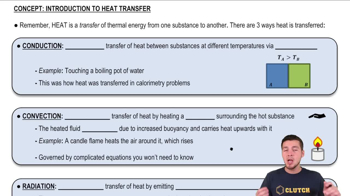
Heat Transfer

Heat transfer is the process by which thermal energy moves from one object or substance to another due to a temperature difference. In this scenario, heat is removed from the water as it freezes, transitioning from a higher temperature to a lower temperature, which is essential for understanding how energy is conserved and transformed in the freezing process.
Video consigliato:
Percorso guidato
05:14
Overview of Heat Transfer

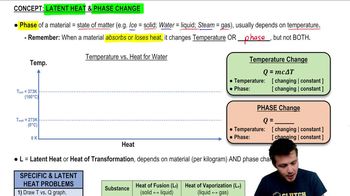
Phase Change

Phase change refers to the transformation of a substance from one state of matter to another, such as from liquid to solid. During this process, the substance absorbs or releases latent heat without changing temperature. In this question, the water undergoes a phase change to ice, which involves calculating the heat energy associated with freezing and cooling the ice further.
Video consigliato:
Percorso guidato
10:40
Latent Heat & Phase Changes

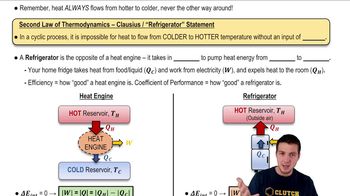
Coefficient of Performance (COP)

The coefficient of performance (COP) is a measure of the efficiency of a refrigeration system, defined as the ratio of heat removed from the cold reservoir to the work input. A COP of 4.0 indicates that for every unit of work input, four units of heat are removed. This concept is crucial for determining how much heat energy is exhausted into the room as the water freezes and the refrigerator operates.
Video consigliato:
Pratica correlata
Domanda del libro di testo

The heat engine shown in FIGURE P21.63 uses 0.020 mol of a diatomic gas as the working substance. Make a table that shows ∆Eth, Ws, and Q for each of the three processes.

195
views

Domanda del libro di testo

A heat engine with 0.20 mol of a monatomic ideal gas initially fills a 2000 cm³ cylinder at 600 K. The gas goes through the following closed cycle: Isothermal expansion to 4000 cm³. Isochoric cooling to 300 K. Isothermal compression to 2000 cm³. Isochoric heating to 600 K. How much work does this engine do per cycle and what is its thermal efficiency?

1407
views
Domanda del libro di testo

The gasoline engine in your car can be modeled as the Otto cycle shown in FIGURE CP21.73. A fuel-air mixture is sprayed into the cylinder at point 1, where the piston is at its farthest distance from the spark plug. This mixture is compressed as the piston moves toward the spark plug during the adiabatic compression stroke. The spark plug fires at point 2, releasing heat energy that had been stored in the gasoline. The fuel burns so quickly that the piston doesn't have time to move, so the heating is an isochoric process. The hot, high-pressure gas then pushes the piston outward during the power stroke. Finally, an exhaust value opens to allow the gas temperature and pressure to drop back to their initial values before starting the cycle over again. Analyze the Otto cycle and show that the work done per cycle is Wout=nR1−γ(T2−T1+T4−T3)W_{\(\text{out}\)} = \(\frac{nR}{1-\gamma}\)(T_2 - T_1 + T_4 - T_3)

1653
views
Domanda del libro di testo

FIGURE CP21.70 shows two insulated compartments separated by a thin wall. The left side contains 0.060 mol of helium at an initial temperature of 600 K and the right side contains 0.030 mol of helium at an initial temperature of 300 K. The compartment on the right is attached to a vertical cylinder, above which the air pressure is 1.0 atm. A 10-cm-diameter, 2.0 kg piston can slide without friction up and down the cylinder. Neither the cylinder diameter nor the volumes of the compartments are known. How much heat is transferred from the left side to the right side?

246
views
Domanda del libro di testo

The heat engine shown in FIGURE P21.62 uses 2.0 mol of a monatomic gas as the working substance. Make a table that shows ∆Eth, Ws, and Q for each of the three processes.

1423
views