Ch 21: Heat Engines and Refrigerators
Knight Calc - Physics for Scientists and Engineers 5th Edition
Knight Calc5th EditionPhysics for Scientists and EngineersISBN: 9780137344796Non è quello che usi tu?Cambia libro di testo
Capitolo 21, Problema 11

A gas following the pV trajectory of FIGURE EX21.11 does 60 J of work per cycle. What is Vmax?

Guida verificata passo dopo passo
1
Identify the relationship between pressure (p), volume (V), and work (W) in a thermodynamic cycle. The work done by the gas in one cycle is equal to the area enclosed by the pV curve in the diagram.
Analyze the pV diagram (FIGURE EX21.11) to determine the shape of the enclosed area. For example, if the trajectory forms a rectangle, triangle, or other geometric shape, the area can be calculated using the appropriate formula.
Express the work done in terms of the pressure and volume changes. For a rectangular cycle, the work is given by \( W = (p_{max} - p_{min})(V_{max} - V_{min}) \). Rearrange this equation to solve for \( V_{max} \): \( V_{max} = \frac{W}{p_{max} - p_{min}} + V_{min} \).
Substitute the given work value (60 J) and the pressure values \( p_{max} \) and \( p_{min} \) from the diagram into the equation. Also, include \( V_{min} \), which is the minimum volume from the diagram.
Perform the algebraic manipulation to isolate \( V_{max} \). Ensure all units are consistent (e.g., pressure in Pascals, volume in cubic meters, and work in Joules) before substituting numerical values.

Risposta video verificata per un problema simile:

Questa soluzione video è stata consigliata dai nostri tutor come utile per risolvere questo problema.

Concetti chiave

Ecco i concetti essenziali che devi comprendere per rispondere correttamente alla domanda.

Work in Thermodynamics

In thermodynamics, work is defined as the energy transferred when a force is applied over a distance. For gases, this is often calculated using the formula W = PΔV, where W is work, P is pressure, and ΔV is the change in volume. Understanding how work is done by or on a gas during expansion or compression is crucial for analyzing thermodynamic cycles.
Video consigliato:
Percorso guidato
07:44
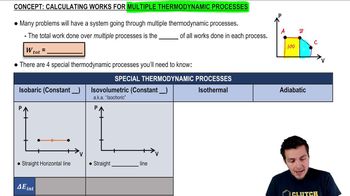
Calculating Works For Multiple Thermodynamic Processes

Pressure-Volume (pV) Diagram

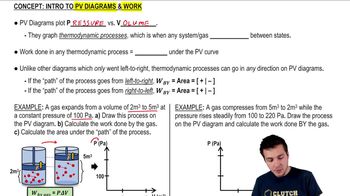
A pressure-volume (pV) diagram is a graphical representation of the relationship between the pressure and volume of a gas during a thermodynamic process. The area under the curve in a pV diagram represents the work done by or on the gas. Analyzing the trajectory on this diagram helps in understanding the different states and processes the gas undergoes in a cycle.
Video consigliato:
Percorso guidato
08:07
Work and PV Diagrams

Max Volume (V_max)

V_max refers to the maximum volume that a gas reaches during its thermodynamic cycle. It is a critical parameter in determining the efficiency and work output of the cycle. To find V_max, one must consider the specific path taken in the pV diagram and the work done, as it directly influences the gas's behavior and the energy transformations occurring within the system.
Video consigliato:
Percorso guidato
05:21
Volume Thermal Expansion