
Ch 21: Heat Engines and Refrigerators
Knight Calc - Physics for Scientists and Engineers 5th Edition
Knight Calc5th EditionPhysics for Scientists and EngineersISBN: 9780137344796Non è quello che usi tu?Cambia libro di testo
Capitolo 21, Problema 52b

A nuclear power plant generates 3000 MW of heat energy from nuclear reactions in the reactor's core. This energy is used to boil water and produce high-pressure steam at 300℃. The steam spins a turbine, which produces 1000 MW of electric power, then the steam is condensed and the water is cooled to 25℃ before starting the cycle again. What is the plant's actual efficiency?

Guida verificata passo dopo passo
1
Step 1: Recall the formula for efficiency, which is the ratio of useful output energy (or power) to the input energy (or power). The formula is: e=PoutPin, where Pout is the output power and Pin is the input power.
Step 2: Identify the given values from the problem. The input power Pin is 3000 MW (heat energy generated), and the output power Pout is 1000 MW (electric power produced).
Step 3: Substitute the given values into the efficiency formula: e=10003000.
Step 4: Simplify the fraction to calculate the efficiency as a decimal. Then, multiply the result by 100 to express the efficiency as a percentage.
Step 5: Interpret the result. The efficiency represents the percentage of input energy that is converted into useful output energy (electric power). The remaining energy is lost, primarily as waste heat.

Risposta video verificata per un problema simile:

Questa soluzione video è stata consigliata dai nostri tutor come utile per risolvere questo problema.
Durata del video:
2m

Concetti chiave

Ecco i concetti essenziali che devi comprendere per rispondere correttamente alla domanda.

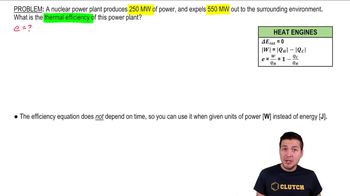
Efficiency

Efficiency in a power plant context refers to the ratio of useful output energy to the input energy. It is expressed as a percentage and indicates how well the plant converts the energy from fuel into usable electrical power. In this case, the efficiency can be calculated by comparing the electric power output to the thermal energy input from nuclear reactions.
Video consigliato:
Percorso guidato
03:55
Efficiency of a Nuclear Power Plant

Thermal Energy

Thermal energy is the total kinetic energy of particles in a substance, which in this scenario is generated from nuclear reactions. The heat energy produced in the reactor core is used to convert water into steam, which is essential for driving the turbine. Understanding the amount of thermal energy produced is crucial for calculating the overall efficiency of the power plant.
Video consigliato:
Percorso guidato
05:21
Volume Thermal Expansion

Turbine Operation

A turbine is a mechanical device that converts thermal energy from steam into mechanical energy, which is then transformed into electrical energy by a generator. The efficiency of the turbine affects the overall efficiency of the power plant, as it determines how much of the steam's energy is converted into electricity. The performance of the turbine is influenced by factors such as steam pressure and temperature.
Video consigliato:
Percorso guidato
08:22
Operations with Significant Figures
Pratica correlata
Domanda del libro di testo

A car's internal combustion engine can be modeled as a heat engine operating between a combustion temperature of 1500℃ and an air temperature of 20℃ with 30% of the Carnot efficiency. The heat of combustion of gasoline is 47 kJ/g. What mass of gasoline is burned to accelerate a 1500 kg car from rest to a speed of 30 m/s?

2095
views
Domanda del libro di testo

Home air conditioners in the United States have their power specified in the truly obscure units of tons, where 1 ton is the power needed to melt 1 ton (2000 lb or 910 kg) of ice in 24 hours. A modest-size house typically has a 4.0 ton air conditioner. If a 4.0 ton air conditioner has a coefficient of performance of 2.5, a typical value, at what rate in kW is heat energy removed from the house?

1696
views
Domanda del libro di testo

A heat engine uses a diatomic gas that follows the pV cycle in FIGURE P21.59. Determine the pressure, volume, and temperature at point 2.

260
views
Domanda del libro di testo

A typical coal-fired power plant burns 300 metric tons of coal every hour to generate 750 MW of electricity. 1 metric ton = 1000 kg. The density of coal is 1500 kg/m³ and its heat of combustion is 28 MJ/kg. Assume that all heat is transferred from the fuel to the boiler and that all the work done in spinning the turbine is transformed into electric energy. Suppose the coal is piled up in a 10 m ✕ 10 m room. How tall must the pile be to operate the plant for one day?

1904
views
Domanda del libro di testo

FIGURE P21.57 shows the cycle for a heat engine that uses a gas having γ = 1.25. The initial temperature is T1 = 300 K, and this engine operates at 20 cycles per second. What is the power output of the engine?

1574
views
Domanda del libro di testo

A heat engine using a diatomic gas follows the cycle shown in FIGURE P21.55. Its temperature at point 1 is 20℃. Determine Ws, Q, and ∆Eth for each of the three processes in this cycle. Display your results in a table.

1397
views