Ch 21: Heat Engines and Refrigerators
Knight Calc - Physics for Scientists and Engineers 5th Edition
Knight Calc5th EditionPhysics for Scientists and EngineersISBN: 9780137344796Non è quello che usi tu?Cambia libro di testo
Capitolo 21, Problema 62a

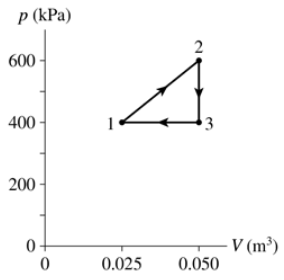
The heat engine shown in FIGURE P21.62 uses 2.0 mol of a monatomic gas as the working substance. Determine T1, T2 and T3.

Guida verificata passo dopo passo
1
Step 1: Identify the states of the gas (1, 2, and 3) from the graph. Note the pressure (p) and volume (V) values for each state. For state 1: p1 = 400 kPa, V1 = 0.050 m³; for state 2: p2 = 600 kPa, V2 = 0.025 m³; for state 3: p3 = 400 kPa, V3 = 0.025 m³.
Step 2: Use the ideal gas law, \( pV = nRT \), to calculate the temperature at each state. Rearrange the formula to \( T = \frac{pV}{nR} \), where n = 2.0 mol and R = 8.314 J/(mol·K). Substitute the values of p and V for each state into the formula.
Step 3: For state 1, substitute \( p_1 = 400 \text{ kPa} = 400 \times 10^3 \text{ Pa} \), \( V_1 = 0.050 \text{ m}^3 \), \( n = 2.0 \text{ mol} \), and \( R = 8.314 \text{ J/(mol·K)} \) into \( T_1 = \frac{p_1 V_1}{nR} \).
Step 4: For state 2, substitute \( p_2 = 600 \text{ kPa} = 600 \times 10^3 \text{ Pa} \), \( V_2 = 0.025 \text{ m}^3 \), \( n = 2.0 \text{ mol} \), and \( R = 8.314 \text{ J/(mol·K)} \) into \( T_2 = \frac{p_2 V_2}{nR} \).
Step 5: For state 3, substitute \( p_3 = 400 \text{ kPa} = 400 \times 10^3 \text{ Pa} \), \( V_3 = 0.025 \text{ m}^3 \), \( n = 2.0 \text{ mol} \), and \( R = 8.314 \text{ J/(mol·K)} \) into \( T_3 = \frac{p_3 V_3}{nR} \).

Risposta video verificata per un problema simile:

Questa soluzione video è stata consigliata dai nostri tutor come utile per risolvere questo problema.

Concetti chiave

Ecco i concetti essenziali che devi comprendere per rispondere correttamente alla domanda.

Ideal Gas Law

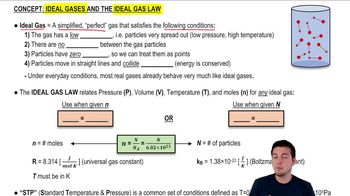
The Ideal Gas Law relates the pressure, volume, temperature, and number of moles of an ideal gas through the equation PV = nRT. Here, P is pressure, V is volume, n is the number of moles, R is the ideal gas constant, and T is temperature. This law is fundamental for understanding the behavior of gases in various thermodynamic processes, including those in heat engines.
Video consigliato:
Percorso guidato
07:21
Ideal Gases and the Ideal Gas Law

Thermodynamic Cycles

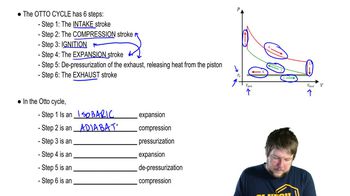
A thermodynamic cycle is a series of processes that involve the transfer of heat and work, returning a system to its initial state. In the context of heat engines, these cycles typically include isothermal, isochoric, isobaric, and adiabatic processes. Understanding these cycles is crucial for analyzing how heat engines operate and for calculating temperatures at different points in the cycle.
Video consigliato:

Work Done by a Gas

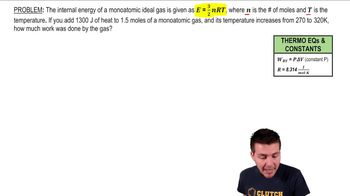
The work done by a gas during expansion or compression can be calculated using the area under the pressure-volume (P-V) curve on a graph. For a heat engine, this work is a key component of its efficiency and performance. The work done is directly related to the changes in volume and pressure, making it essential for determining the temperatures at various states in the cycle.
Video consigliato:
Percorso guidato
03:47
Calculating Work Done on Monoatomic Gas