
Ch 22: Electric Charges and Forces
Knight Calc - Physics for Scientists and Engineers 5th Edition
Knight Calc5th EditionPhysics for Scientists and EngineersISBN: 9780137344796Non è quello che usi tu?Cambia libro di testo
Capitolo 22, Problema 4b

A glass rod that has been charged to +12 nC touches a metal sphere. Afterward, the rod’s charge is +8.0 nC. How many charged particles were transferred?

Guida verificata passo dopo passo
1
Understand the problem: The glass rod initially has a charge of +12 nC, and after touching the metal sphere, its charge decreases to +8.0 nC. This means some charge was transferred from the rod to the sphere. The goal is to calculate the number of charged particles (electrons) transferred.
Calculate the amount of charge transferred: Subtract the final charge of the rod from its initial charge. The formula is ΔQ = Q_initial - Q_final, where Q_initial = 12 nC and Q_final = 8.0 nC. This will give the charge transferred in coulombs.
Convert the charge transferred from nanocoulombs (nC) to coulombs (C): Use the conversion factor 1 nC = 1 × 10⁻⁹ C. Multiply the charge transferred (ΔQ) by this factor to express it in coulombs.
Determine the number of electrons transferred: Use the relationship between charge and the elementary charge of an electron. The formula is N = ΔQ / e, where e = 1.6 × 10⁻¹⁹ C (the charge of a single electron). Divide the charge transferred (in coulombs) by the elementary charge to find the number of electrons.
Interpret the result: The value of N represents the number of electrons transferred from the rod to the sphere. Since electrons are negatively charged, the transfer of electrons reduces the positive charge on the rod.

Risposta video verificata per un problema simile:

Questa soluzione video è stata consigliata dai nostri tutor come utile per risolvere questo problema.
Durata del video:
3m

Concetti chiave

Ecco i concetti essenziali che devi comprendere per rispondere correttamente alla domanda.

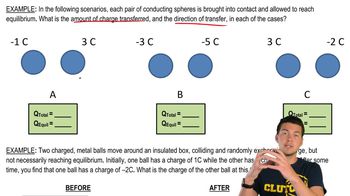
Charge Conservation

Charge conservation is a fundamental principle in physics stating that the total electric charge in an isolated system remains constant over time. When two objects interact, such as a charged rod and a metal sphere, charge can be transferred between them, but the overall charge before and after the interaction must remain the same.
Video consigliato:
Percorso guidato
05:43
Conservation of Charge

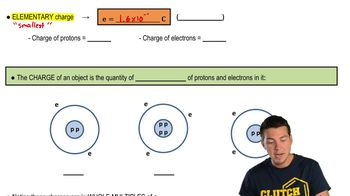
Quantization of Charge

Electric charge is quantized, meaning it exists in discrete amounts, typically in multiples of the elementary charge (approximately 1.6 x 10^-19 coulombs). This concept is crucial for understanding how many elementary charges (or charged particles) are involved in the transfer of charge between objects, as each particle carries a specific amount of charge.
Video consigliato:
Percorso guidato
05:37
Electric Charge

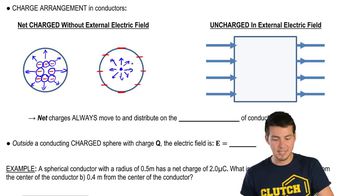
Conductors and Charge Transfer

Conductors are materials that allow electric charge to flow freely due to the presence of free electrons. When a charged object, like a glass rod, touches a conductor such as a metal sphere, charge can redistribute between them, leading to a change in their respective charge states. This interaction is key to determining how many charged particles are transferred during the process.
Video consigliato:
Percorso guidato
07:43
Electric Fields in Conductors