Ch 22: Electric Charges and Forces
Knight Calc - Physics for Scientists and Engineers 5th Edition
Knight Calc5th EditionPhysics for Scientists and EngineersISBN: 9780137344796Non è quello che usi tu?Cambia libro di testo
Capitolo 22, Problema 24

A massless spring is attached to a support at one end and has a 2.0 μC charge glued to the other end. A −4.0 μC charge is slowly brought near. The spring has stretched 1.2 cm when the charges are 2.6 cm apart. What is the spring constant of the spring?

Guida verificata passo dopo passo
1
Identify the forces acting on the system. The spring is stretched due to the electrostatic force between the two charges. The electrostatic force is given by Coulomb's law: F=ke⋅q1⋅q2r2, where q1 and q2 are the charges, r is the distance between them, and ke is Coulomb's constant (ke=8.99×10⁹ N·m²/C²).
Relate the electrostatic force to the spring force. The spring force is given by Hooke's law: F=k⋅x, where k is the spring constant and x is the displacement of the spring. At equilibrium, the spring force equals the electrostatic force: ke⋅q1q2/r2=k⋅x.
Substitute the known values into Coulomb's law. Use q1=2.0×10⁻⁶ C, q2=-4.0×10⁻⁶ C, r=2.6×10⁻² m, and ke=8.99×10⁹ N·m²/C² to calculate the electrostatic force: F=ke⋅q1⋅q2r2.
Set the electrostatic force equal to the spring force. Use the displacement of the spring, x=1.2×10⁻² m, and solve for the spring constant k: k=Fx.
Simplify the expression to find the spring constant. Substitute the value of the electrostatic force from step 3 and the displacement of the spring into the equation from step 4 to calculate k.

Risposta video verificata per un problema simile:

Questa soluzione video è stata consigliata dai nostri tutor come utile per risolvere questo problema.
Durata del video:
8m

Concetti chiave

Ecco i concetti essenziali che devi comprendere per rispondere correttamente alla domanda.

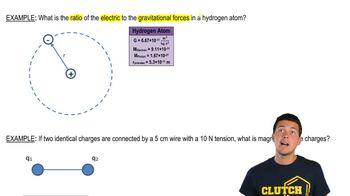
Coulomb's Law

Coulomb's Law describes the electrostatic force between two charged objects. It states that the force is directly proportional to the product of the magnitudes of the charges and inversely proportional to the square of the distance between them. This law is essential for calculating the force acting on the spring due to the charges.
Video consigliato:

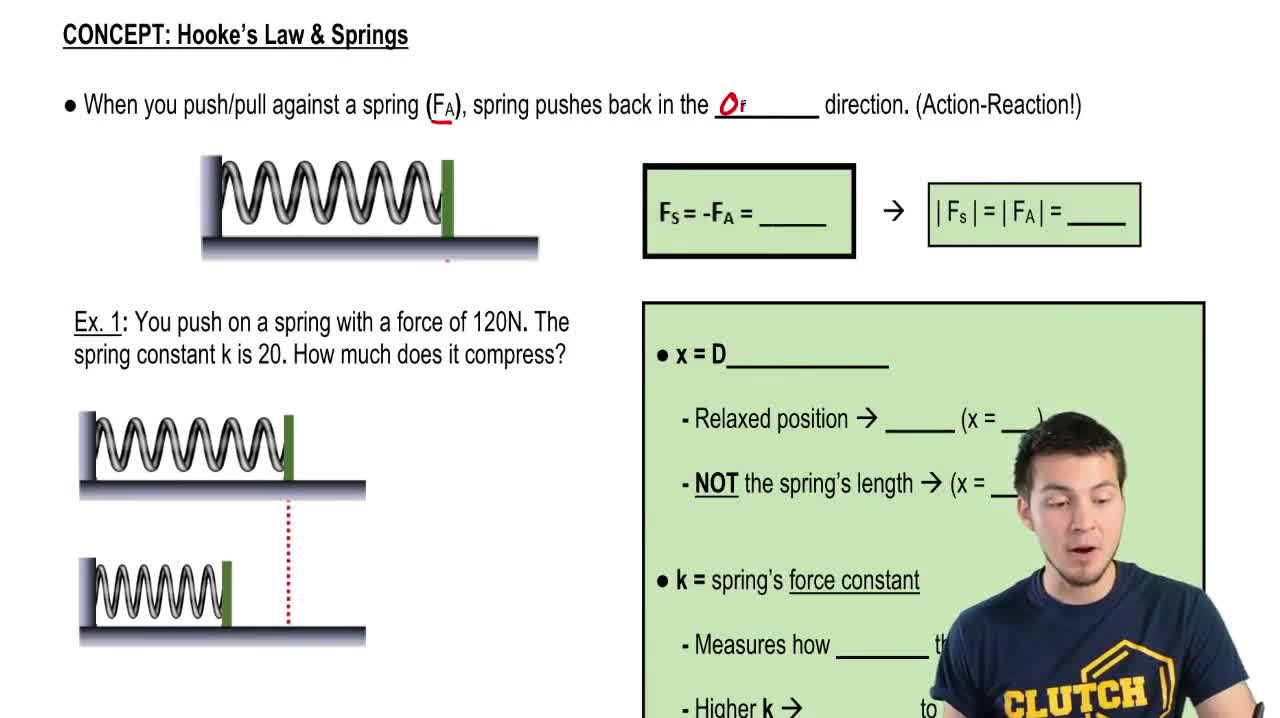
Hooke's Law

Hooke's Law states that the force exerted by a spring is proportional to its extension or compression from its equilibrium position. Mathematically, it is expressed as F = kx, where F is the force, k is the spring constant, and x is the displacement. This principle is crucial for determining the spring constant in the context of the problem.
Video consigliato:
Percorso guidato
05:27
Spring Force (Hooke's Law)

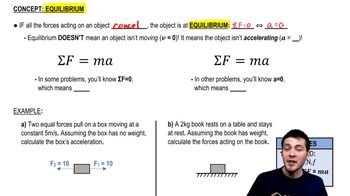
Equilibrium of Forces

In this scenario, the system reaches equilibrium when the electrostatic force exerted by the charges equals the restoring force of the spring. Understanding this balance is key to solving for the spring constant, as it allows us to set the forces equal to each other and solve for the unknown variable.
Video consigliato: