
Ch 23: The Electric Field
Knight Calc - Physics for Scientists and Engineers 5th Edition
Knight Calc5th EditionPhysics for Scientists and EngineersISBN: 9780137344796Non è quello che usi tu?Cambia libro di testo
Capitolo 23, Problema 43

Derive Equation 23.11 for the field Ē dipole in the plane that bisects an electric dipole.

Guida verificata passo dopo passo
1
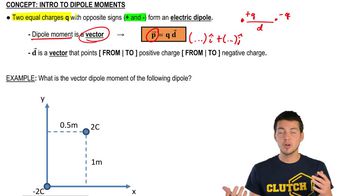
Start by recalling the configuration of an electric dipole. An electric dipole consists of two charges, +q and -q, separated by a distance d. The dipole moment \( \mathbf{p} \) is defined as \( \mathbf{p} = q \cdot \mathbf{d} \), where \( \mathbf{d} \) is the vector pointing from the negative charge to the positive charge.
In the plane that bisects the dipole (the perpendicular bisector), the contributions to the electric field from the positive and negative charges will have components that cancel along the axis of the dipole. Only the components perpendicular to the dipole axis will add up.
The electric field due to a point charge is given by \( \mathbf{E} = \frac{1}{4 \pi \epsilon_0} \frac{q}{r^2} \hat{r} \), where \( r \) is the distance from the charge and \( \hat{r} \) is the unit vector pointing from the charge to the observation point. For the dipole, calculate the field contributions from both charges at a point on the bisector.
Using geometry, express the distance from each charge to the observation point in terms of the dipole separation \( d \) and the perpendicular distance \( r \) from the dipole axis. Approximate for \( r \gg d \) (far-field approximation) to simplify the expressions for the electric field components.
Combine the contributions from both charges, keeping only the perpendicular components. Simplify the resulting expression to derive the electric field on the bisector plane: \( \mathbf{E} = -\frac{1}{4 \pi \epsilon_0} \frac{p}{r^3} \hat{r} \), where \( p \) is the magnitude of the dipole moment and \( r \) is the distance from the dipole center to the observation point.

Risposta video verificata per un problema simile:

Questa soluzione video è stata consigliata dai nostri tutor come utile per risolvere questo problema.

Concetti chiave

Ecco i concetti essenziali che devi comprendere per rispondere correttamente alla domanda.

Electric Dipole

An electric dipole consists of two equal and opposite charges separated by a distance. It is characterized by its dipole moment, which is a vector quantity pointing from the negative to the positive charge. The dipole moment is crucial for understanding the electric field generated by the dipole, especially in the context of deriving equations related to its field distribution.
Video consigliato:
Percorso guidato
03:08
Intro To Dipole Moment

Electric Field (E-field)

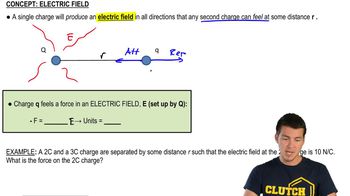
The electric field is a vector field that represents the force exerted by an electric charge on other charges in its vicinity. For a dipole, the electric field can be derived from the superposition of the fields due to each charge. Understanding how to calculate the electric field in different regions, particularly in the plane bisecting the dipole, is essential for deriving the relevant equations.
Video consigliato:
Percorso guidato
03:16
Intro to Electric Fields

Field Lines and Symmetry

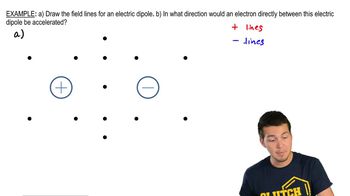
Field lines are a visual representation of the electric field, indicating the direction and strength of the field. The symmetry of the dipole configuration allows for simplifications in calculations, particularly in the plane that bisects the dipole. Recognizing the symmetry helps in deriving equations by focusing on the contributions of the dipole's charges and their resultant field in specific regions.
Video consigliato:
Percorso guidato
08:20
Electric Field Lines
Pratica correlata
Domanda del libro di testo

Charge Q is uniformly distributed along a thin, flexible rod of length L. The rod is then bent into the semicircle shown in FIGURE P23.48. Find an expression for the electric field Ē at the center of the semicircle. Hint: A small piece of arc length Δs spans a small angle Δθ=Δs/R , where R is the radius.

2102
views
Domanda del libro di testo

What are the strength and direction of the electric field at the position indicated by the dot in FIGURE P23.37? Give your answer (a) in component form and (b) as a magnitude and angle measured cw or ccw (specify which) from the positive x-axis.

210
views
Domanda del libro di testo

A −15 nC charge is at x=+2.0 cm on the x-axis. A second charge q is located somewhere on the x-axis to the left of the origin. The electric field at y=2.0 cm on the y-axis is E→=3.0×10⁵i^\(\overrightarrow{E}\)=3.0\(\times\)10^5\(\hat{i}\)N/C . What are (a) the charge q in nC and (b) its distance from the origin?

2589
views
Domanda del libro di testo

FIGURE P23.44 shows a thin rod of length L with total charge Q. Evaluate E at r=3.0 cm if L=5.0 cm and Q=3.0 nC.

73
views
Domanda del libro di testo

FIGURE P23.41 is a cross section of two infinite lines of charge that extend out of the page. Both have linear charge density λ. Find an expression for the electric field strength E at height y above the midpoint between the lines.

2267
views
Domanda del libro di testo

A ring of radius R has total charge Q. At what distance along the z-axis is the electric field strength a maximum?

49
views