Ch 23: The Electric Field
Knight Calc - Physics for Scientists and Engineers 5th Edition
Knight Calc5th EditionPhysics for Scientists and EngineersISBN: 9780137344796Non è quello che usi tu?Cambia libro di testo
Capitolo 23, Problema 29

INT The surface charge density on an infinite charged plane is −2.0×10⁻⁶ C/m2. A proton is shot straight away from the plane at 2.0×10⁶ m/s. How far does the proton travel before reaching its turning point?

Guida verificata passo dopo passo
1
Step 1: Recognize that the problem involves a charged plane creating an electric field and a proton moving in this field. The turning point occurs when the proton's initial kinetic energy is completely converted into electric potential energy.
Step 2: Calculate the electric field (E) created by the infinite charged plane using the formula for an infinite plane: E = rac{\(\text{σ}\)}{2\(\text{ε}\)_0}, where \(\text{σ}\) = -2.0 imes 10^{-6} \(\text{ C/m}\)^2 is the surface charge density and \(\text{ε}\)_0 = 8.85 imes 10^{-12} \(\text{ C}\)^2/\(\text{N·m}\)^2 is the permittivity of free space.
Step 3: Write the energy conservation equation. The initial kinetic energy of the proton is given by KE = rac{1}{2}mv^2, where m = 1.67 imes 10^{-27} \(\text{ kg}\) is the mass of the proton and v = 2.0 imes 10^6 \(\text{ m/s}\) is its initial velocity. The electric potential energy at the turning point is U = qEd, where q = 1.6 imes 10^{-19} \(\text{ C}\) is the charge of the proton, E is the electric field, and d is the distance traveled by the proton.
Step 4: Set the initial kinetic energy equal to the electric potential energy at the turning point: rac{1}{2}mv^2 = qEd. Solve for d: d = rac{ rac{1}{2}mv^2}{qE}.
Step 5: Substitute the known values for m, v, q, and E into the equation for d to find the distance the proton travels before reaching its turning point.

Risposta video verificata per un problema simile:

Questa soluzione video è stata consigliata dai nostri tutor come utile per risolvere questo problema.
Durata del video:
7m

Concetti chiave

Ecco i concetti essenziali che devi comprendere per rispondere correttamente alla domanda.

Electric Field due to a Charged Plane

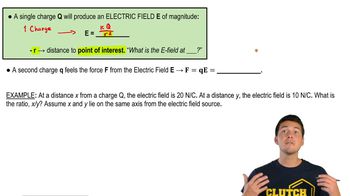
An infinite charged plane creates a uniform electric field that is constant in magnitude and direction. The electric field (E) produced by a surface charge density (σ) is given by E = σ / (2ε₀), where ε₀ is the permittivity of free space. This electric field exerts a force on charged particles, such as protons, causing them to accelerate or decelerate depending on the charge and direction of the field.
Video consigliato:
Percorso guidato
06:28
Electric Field due to a Point Charge

Kinematics of Charged Particles

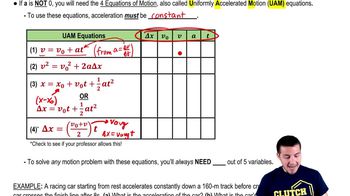
The motion of charged particles in an electric field can be analyzed using kinematic equations. When a proton is shot away from a charged plane, it experiences a force due to the electric field, which affects its velocity and position over time. The turning point occurs when the proton's velocity becomes zero, allowing us to use energy conservation or kinematic equations to determine the distance traveled before this point.
Video consigliato:
Percorso guidato
08:25
Kinematics Equations

Conservation of Energy

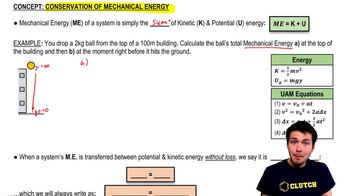
The principle of conservation of energy states that the total mechanical energy of a system remains constant if only conservative forces are acting. In this scenario, the kinetic energy of the proton is converted into electric potential energy as it moves against the electric field. By equating the initial kinetic energy to the potential energy at the turning point, we can calculate the distance the proton travels before stopping.
Video consigliato:
Percorso guidato
06:24
Conservation Of Mechanical Energy
Pratica correlata
Domanda del libro di testo

FIGURE EX23.25 shows a 1.51.5 g ball hanging from a string inside a parallel-plate capacitor made with 12 cm × 12 cm electrodes. The electrodes are charged to±75 nC. What is the charge on the ball in nC?

2512
views
1
rank

Domanda del libro di testo

A proton is fired horizontally into a 1.0×10⁵ N/C vertical electric field. It rises 1.0 cm vertically after having traveled 5.0 cm horizontally. What was the proton's initial speed?

2173
views
1
rank
Domanda del libro di testo

Air 'breaks down' when the electric field strength reaches 3.0×10⁶ N/C, causing a spark. A parallel-plate capacitor is made from two 4.0 cm×4.0 cm electrodes. How many electrons must be transferred from one electrode to the other to create a spark between the electrodes?

244
views
Domanda del libro di testo

Electrostatic cleaners remove small dust particles and pollen grains from air by first ionizing them, then flowing the air between the plates of a parallel-plate capacitor, parallel to the plates, where electric forces deposit charged particles on one of the electrodes. A typical pollen grain has a mass of 5.0×10−105.0\(\times\)10^{-10} g, the ionizer charges it with 750750 extra electrons, and a fan moves the air at 3.03.0 m/s. Ignore air resistance and gravity. What minimum electric field strength is needed to deflect the grain by 3.03.0 mm before it leaves the electrodes?

1923
views
Domanda del libro di testo

Two 2.0-cm-diameter disks face each other, 1.0 mm apart. They are charged to ±10 nC. A proton is shot from the negative disk toward the positive disk. What launch speed must the proton have to just barely reach the positive disk?

202
views
Domanda del libro di testo

The permanent electric dipole moment of the water molecule (H2O) is 6.2×10−306.2\(\times\)10^{-30} Cm. What is the maximum possible torque on a water molecule in a 5.0×1085.0×10^8 N/C electric field?

2672
views