
Ch 24: Gauss' Law
Knight Calc - Physics for Scientists and Engineers 5th Edition
Knight Calc5th EditionPhysics for Scientists and EngineersISBN: 9780137344796Non è quello che usi tu?Cambia libro di testo
Capitolo 24, Problema 58c

An infinite cylinder of radius R has a linear charge density λ. The volume charge density (C/m3) within the cylinder (r ≤ R) is p(r)=rp0/Rp(r) = rp_0 / R, where p₀ is a constant to be determined. Use Gauss’s law to find an expression for the electric field strength E inside the cylinder, r ≤ R, in terms of λ and R.

Guida verificata passo dopo passo
1
Start by recalling Gauss's law, which states that the electric flux through a closed surface is proportional to the total charge enclosed by that surface. Mathematically, it is expressed as: ∮E·dA = Q_enclosed / ε₀, where E is the electric field, dA is the infinitesimal area element, Q_enclosed is the total charge enclosed by the Gaussian surface, and ε₀ is the permittivity of free space.
Choose a cylindrical Gaussian surface of radius r (where r ≤ R) and length L, coaxial with the charged cylinder. The symmetry of the problem ensures that the electric field E is radial and constant in magnitude over the curved surface of the Gaussian cylinder.
Calculate the total charge enclosed within the Gaussian surface. The volume charge density is given as p(r) = (r * p₀) / R. The infinitesimal charge element in a cylindrical shell of radius r and thickness dr is dQ = p(r) * (2πrL * dr). Integrate this expression from 0 to r to find the total charge enclosed: Q_enclosed = ∫[0 to r] [(r * p₀) / R] * (2πrL) dr.
Perform the integration: Q_enclosed = (2πL * p₀ / R) ∫[0 to r] r² dr. The integral of r² is (r³ / 3), so Q_enclosed = (2πL * p₀ / R) * (r³ / 3). Simplify this to Q_enclosed = (2πL * p₀ * r³) / (3R).
Apply Gauss's law: ∮E·dA = E * (2πrL) = Q_enclosed / ε₀. Substitute Q_enclosed into this equation: E * (2πrL) = [(2πL * p₀ * r³) / (3R)] / ε₀. Simplify to find the electric field: E = (p₀ * r²) / (3R * ε₀). Finally, relate p₀ to λ using the total charge of the cylinder (λ = ∫[0 to R] p(r) * 2πr dr), and substitute this into the expression for E.

Risposta video verificata per un problema simile:

Questa soluzione video è stata consigliata dai nostri tutor come utile per risolvere questo problema.

Concetti chiave

Ecco i concetti essenziali che devi comprendere per rispondere correttamente alla domanda.

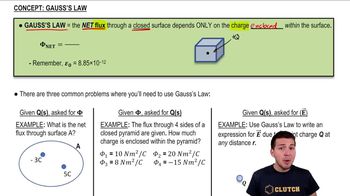
Gauss's Law

Gauss's Law relates the electric flux through a closed surface to the charge enclosed by that surface. Mathematically, it states that the total electric flux is equal to the enclosed charge divided by the permittivity of free space. This principle is fundamental in electrostatics, allowing for the calculation of electric fields in symmetric charge distributions, such as cylinders.
Video consigliato:

Linear Charge Density

Linear charge density (λ) is defined as the amount of electric charge per unit length along a line, typically measured in coulombs per meter (C/m). In the context of the infinite cylinder, λ represents the charge distributed uniformly along the length of the cylinder, influencing the electric field generated around and within the cylinder.
Video consigliato:
Percorso guidato
8:13
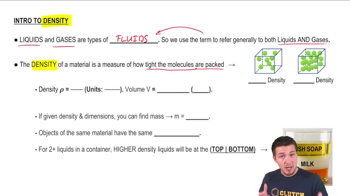
Intro to Density

Volume Charge Density

Volume charge density (ρ) describes the distribution of electric charge per unit volume, expressed in coulombs per cubic meter (C/m³). In this problem, the volume charge density varies with the radial distance (r) from the center of the cylinder, which affects the electric field inside the cylinder. Understanding how ρ is defined and varies is crucial for applying Gauss's Law effectively.
Video consigliato:
Percorso guidato
04:33
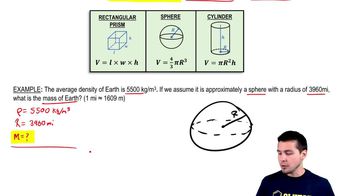
Problems with Mass, Volume, & Density
Pratica correlata
Domanda del libro di testo

All examples of Gauss’s law have used highly symmetric surfaces where the flux integral is either zero or EA. Yet we’ve claimed that the net Φₑ = Qᵢₙ / ϵ₀ is independent of the surface. This is worth checking. FIGURE CP24.57 shows a cube of edge length L centered on a long thin wire with linear charge density λ. The flux through one face of the cube is not simply EA because, in this case, the electric field varies in both strength and direction. But you can calculate the flux by actually doing the flux integral. Now integrate dΦ to find the total flux through this face.

1924
views
Domanda del libro di testo

An infinite cylinder of radius R has a linear charge density λ . The volume charge density (C/m³) within the cylinder (r ≤ R ) is p (r) = rp₀ / R, where p₀ is a constant to be determined. The charge within a small volume dV is dq = pdV. The integral of pdV over a cylinder of length L is the total charge Q = λL within the cylinder. Use this fact to show that p₀ = 3λ / 2πR² Hint: Let dV be a cylindrical shell of length L, radius r, and thickness dr. What is the volume of such a shell?

2017
views
Domanda del libro di testo

A spherical ball of charge has radius R and total charge Q. The electric field strength inside the ball (r ≤ R ) is E(r)=r4Emax/R4E(r)=r^4E_{max}/R^4. Find an expression for the volume charge density ρ(r) inside the ball as a function of r.

1867
views
Domanda del libro di testo

A sphere of radius R has total charge Q. The volume charge density (C/m³) within the sphere is p(r) = C/r², where C is a constant to be determined. Use Gauss’s law to find an expression for the electric field strength E inside the sphere, r ≤ R, in terms of Q and R.

124
views
Domanda del libro di testo

All examples of Gauss’s law have used highly symmetric surfaces where the flux integral is either zero or EA. Yet we’ve claimed that the net Φe=Qin/ϵ0\(\Phi\)_{e}=Q_{in}/\(\epsilon\)_0 is independent of the surface. This is worth checking. FIGURE CP24.57 shows a cube of edge length L centered on a long thin wire with linear charge density λ. The flux through one face of the cube is not simply EA because, in this case, the electric field varies in both strength and direction. But you can calculate the flux by actually doing the flux integral. Show that the net flux through the cube is Φe=Qin/ϵ0\(\Phi\)_{e}=Q_{in}/\(\epsilon\)_0.

192
views