
Ch 24: Gauss' Law
Knight Calc - Physics for Scientists and Engineers 5th Edition
Knight Calc5th EditionPhysics for Scientists and EngineersISBN: 9780137344796Non è quello che usi tu?Cambia libro di testo
Capitolo 24, Problema 4

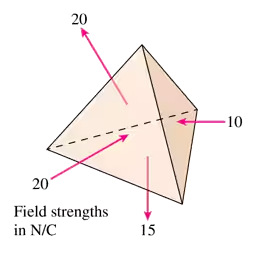
The electric field is constant over each face of the tetrahedron shown in FIGURE EX24.4. Does the box contain positive charge, negative charge, or no charge? Explain.
Tetrahedron with labeled electric field strengths: 20, 20, 15, and 10 N/C on its faces, illustrating Gauss' Law.

Guida verificata passo dopo passo
1
Understand the problem: The question is asking whether the tetrahedron contains positive charge, negative charge, or no charge. To determine this, we will use Gauss's law, which relates the electric flux through a closed surface to the charge enclosed within that surface.
Recall Gauss's law: Gauss's law states that the net electric flux (Φ) through a closed surface is proportional to the total charge (Q) enclosed within the surface. Mathematically, it is expressed as: ∮E⋅dA = Q/ε₀, where E is the electric field, dA is the infinitesimal area vector, and ε₀ is the permittivity of free space.
Analyze the electric field: The problem states that the electric field is constant over each face of the tetrahedron. This means that the electric flux through each face can be calculated as the product of the electric field magnitude and the area of the face, taking into account the direction of the field relative to the surface normal.
Calculate the net electric flux: To determine the net flux, sum the contributions of the electric flux through all four faces of the tetrahedron. If the net flux is zero, it implies no net charge is enclosed. If the net flux is positive, it indicates a positive charge is enclosed, and if negative, it indicates a negative charge is enclosed.
Interpret the result: Based on the net electric flux calculated in the previous step, conclude whether the tetrahedron contains positive charge, negative charge, or no charge. If the flux is zero, the box contains no charge. If the flux is nonzero, the sign of the flux will indicate the type of charge enclosed.

Risposta video verificata per un problema simile:

Questa soluzione video è stata consigliata dai nostri tutor come utile per risolvere questo problema.

Concetti chiave

Ecco i concetti essenziali che devi comprendere per rispondere correttamente alla domanda.

Electric Field

An electric field is a region around a charged object where other charged objects experience a force. It is represented by field lines that indicate the direction and strength of the force. The electric field is defined as the force per unit charge, and its direction is taken to be the direction a positive test charge would move.
Video consigliato:
Percorso guidato
03:16
Intro to Electric Fields

Gauss's Law

Gauss's Law relates the electric flux through a closed surface to the charge enclosed by that surface. Mathematically, it states that the total electric flux is proportional to the enclosed charge. This principle is crucial for determining the presence of charge within a given volume, such as the tetrahedron in the question.
Video consigliato:

Charge Distribution

Charge distribution refers to how electric charge is spread out in a given space. It can be uniform or non-uniform, and it affects the electric field in that region. Understanding whether the charge is positive, negative, or neutral helps in analyzing the behavior of the electric field and the forces acting on charges within the tetrahedron.
Video consigliato:
Percorso guidato
04:03
Probability Distribution Graph
Pratica correlata
Domanda del libro di testo

The cube in FIGURE EX24.7 contains negative charge. The electric field is constant over each face of the cube. Does the missing electric field vector on the front face point in or out? What strength must this field exceed?

252
views
Domanda del libro di testo

FIGURE EX24.2 shows a cross section of two concentric spheres. The inner sphere has a negative charge. The outer sphere has a positive charge larger in magnitude than the charge on the inner sphere. Draw this figure on your paper, then draw electric field vectors showing the shape of the electric field.

168
views
Domanda del libro di testo

FIGURE EX24.1 shows two cross sections of two infinitely long coaxial cylinders. The inner cylinder has a positive charge, the outer cylinder has an equal negative charge. Draw this figure on your paper, then draw electric field vectors showing the shape of the electric field.

1236
views
Domanda del libro di testo

The electric flux through the surface shown in FIGURE EX24.10 is 25 N m²/C. What is the electric field strength?

2341
views
Domanda del libro di testo

A 2.0 cm × 3.0 cm rectangle lies in the xzxz-plane with unit vector n^\(\hat{n}\) pointing in the +y-direction. What is the electric flux through the rectangle if the electric field is E→=(4000i^−2000k^)\(\overrightarrow{E}\)=(4000\(\hat{i}\)-2000\(\hat{k}\)) N/C?

2287
views
Domanda del libro di testo

FIGURE EX24.3 shows a cross section of two infinite parallel planes of charge. Draw this figure on your paper, then draw electric field vectors showing the shape of the electric field.

228
views