Ch 26: Potential and Field
Knight Calc - Physics for Scientists and Engineers 5th Edition
Knight Calc5th EditionPhysics for Scientists and EngineersISBN: 9780137344796Non è quello che usi tu?Cambia libro di testo
Capitolo 26, Problema 5a

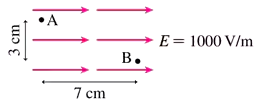
Which point in FIGURE EX26.5, A or B, has a larger electric potential?
Diagram comparing electric potential at points A and B, with arrows indicating electric field direction and strength.

Guida verificata passo dopo passo
1
Step 1: Understand the relationship between electric potential and electric field. The electric potential decreases in the direction of the electric field. The formula for the change in electric potential is ΔV = -E * d, where E is the magnitude of the electric field and d is the distance moved in the direction of the field.
Step 2: Analyze the diagram. The electric field is uniform and directed horizontally to the right, with a magnitude of E = 1000 V/m. Points A and B are separated vertically by 3 cm and horizontally by 7 cm.
Step 3: Determine the relative positions of points A and B. Point A is higher vertically, while point B is lower and further to the right. Since the electric field is horizontal, the vertical separation does not affect the electric potential difference.
Step 4: Calculate the horizontal displacement between points A and B. The horizontal distance is 7 cm (0.07 m). Use the formula ΔV = -E * d to find the potential difference due to this displacement. Since point B is further to the right, it is in the direction of the electric field, meaning its potential is lower than point A.
Step 5: Conclude that point A has a larger electric potential than point B because the electric potential decreases in the direction of the electric field, and point B is further along the field direction.

Risposta video verificata per un problema simile:

Questa soluzione video è stata consigliata dai nostri tutor come utile per risolvere questo problema.

Concetti chiave

Ecco i concetti essenziali che devi comprendere per rispondere correttamente alla domanda.

Electric Potential

Electric potential, measured in volts, represents the potential energy per unit charge at a point in an electric field. It indicates how much work is needed to move a charge from a reference point to a specific point within the field. In this context, the electric potential at points A and B can be compared based on their positions relative to the electric field.
Video consigliato:
Percorso guidato
07:33
Electric Potential

Electric Field

An electric field is a region around a charged object where other charged objects experience a force. It is represented by field lines, with the direction indicating the force on a positive charge. The strength of the electric field (E) is given in volts per meter (V/m) and affects the electric potential at different points within the field.
Video consigliato:
Percorso guidato
03:16
Intro to Electric Fields

Relationship Between Electric Field and Potential

The relationship between electric field and electric potential is defined by the equation E = -dV/dx, where E is the electric field strength and dV/dx is the change in electric potential over distance. This means that in a uniform electric field, the potential decreases in the direction of the field. Thus, the point closer to the positive charge will have a higher electric potential.
Video consigliato:
Percorso guidato
03:43
Relationships Between Force, Field, Energy, Potential