

Consider a uniformly charged sphere of radius R and total charge Q. The electric field Eout outside the sphere (r≥R) is simply that of a point charge Q. In Chapter 24, we used Gauss’s law to find that the electric field Ein inside the sphere (r≤R) is radially outward with field strength . What is the ratio Vcenter/Vsurface?
Ch 26: Potential and Field
Knight Calc5th EditionPhysics for Scientists and EngineersISBN: 9780137344796Non è quello che usi tu?Cambia libro di testo
Capitolo 26, Problema 81b
A spherical capacitor with a 1.0 mm gap between the shells has a capacitance of 100 pF. What are the diameters of the two spheres?
Guida verificata passo dopo passo1
Understand the formula for the capacitance of a spherical capacitor: \( C = \frac{4 \pi \varepsilon_0}{\frac{1}{r_1} - \frac{1}{r_2}} \), where \( r_1 \) and \( r_2 \) are the radii of the inner and outer spheres, respectively, and \( \varepsilon_0 \) is the permittivity of free space.
Rearrange the formula to solve for \( r_1 \) and \( r_2 \): \( \frac{1}{r_1} - \frac{1}{r_2} = \frac{4 \pi \varepsilon_0}{C} \). Note that the gap between the spheres is given as 1.0 mm, so \( r_2 - r_1 = 1.0 \times 10^{-3} \) m.
Substitute the given values: \( C = 100 \times 10^{-12} \) F and \( \varepsilon_0 = 8.85 \times 10^{-12} \) F/m. This allows you to calculate \( \frac{4 \pi \varepsilon_0}{C} \).
Use the relationship \( r_2 = r_1 + 1.0 \times 10^{-3} \) m to express \( r_2 \) in terms of \( r_1 \). Substitute this into the rearranged formula to create an equation involving only \( r_1 \).
Solve the equation for \( r_1 \), then use \( r_2 = r_1 + 1.0 \times 10^{-3} \) m to find \( r_2 \). Finally, calculate the diameters of the spheres as \( 2r_1 \) and \( 2r_2 \).

Risposta video verificata per un problema simile:
Questa soluzione video è stata consigliata dai nostri tutor come utile per risolvere questo problema.
Concetti chiave
Ecco i concetti essenziali che devi comprendere per rispondere correttamente alla domanda.
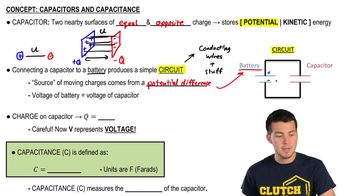
Capacitance
Capacitance is the ability of a system to store electric charge per unit voltage. It is measured in farads (F) and is defined by the formula C = Q/V, where C is capacitance, Q is the charge stored, and V is the voltage across the capacitor. In spherical capacitors, the capacitance depends on the geometry of the spheres and the dielectric medium between them.
Video consigliato:
Percorso guidato
Capacitors & Capacitance (Intro)
Spherical Capacitor
A spherical capacitor consists of two concentric spherical conductors separated by an insulating gap. The capacitance of a spherical capacitor can be calculated using the formula C = 4πε₀(R₁R₂)/(R₂ - R₁), where R₁ and R₂ are the radii of the inner and outer spheres, respectively, and ε₀ is the permittivity of free space. The geometry significantly influences the capacitor's ability to store charge.
Video consigliato:
Percorso guidato
Refraction at Spherical Surfaces
Dielectric Gap
The dielectric gap in a capacitor is the space between the two conductive plates or shells, which can affect the capacitance. In the case of a spherical capacitor, the gap is the distance between the inner and outer spheres. A smaller gap generally increases capacitance, as it allows for a stronger electric field and greater charge storage capability, assuming the dielectric material remains constant.
Video consigliato:
Percorso guidato
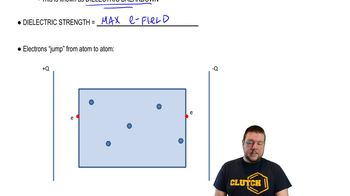
Dielectric Breakdown
Pratica correlata
Domanda del libro di testo
1930
views
Domanda del libro di testo
Charge is uniformly distributed with charge density ρ inside a very long cylinder of radius R. Find the potential difference between the surface and the axis of the cylinder.
112
views
Domanda del libro di testo
Each capacitor in FIGURE CP26.83 has capacitance C. What is the equivalent capacitance between points a and b?
234
views
Domanda del libro di testo
Find an expression for the capacitance of a spherical capacitor, consisting of concentric spherical shells of radii R1 (inner shell) and R2 (outer shell).
141
views
