
Ch 26: Potential and Field
Knight Calc - Physics for Scientists and Engineers 5th Edition
Knight Calc5th EditionPhysics for Scientists and EngineersISBN: 9780137344796Non è quello che usi tu?Cambia libro di testo
Capitolo 26, Problema 52b

Two 2.0 cm×2.0 cm metal electrodes are spaced 1.0 mm apart and connected by wires to the terminals of a 9.0 V battery. The wires are disconnected, and insulated handles are used to pull the plates apart to a new spacing of 2.0 mm. What are the charge on each electrode and the potential difference between them?

Guida verificata passo dopo passo
1
Calculate the initial capacitance of the parallel plate capacitor using the formula: C=εd⋅A, where ε is the permittivity of free space, A is the area of the plates, and d is the separation between the plates.
Determine the charge on each electrode using the relationship Q=C⋅V, where V is the potential difference (9.0 V in this case).
When the plates are pulled apart to a new spacing of 2.0 mm, note that the charge Q remains constant because the wires are disconnected, meaning no charge can flow.
Recalculate the new capacitance using the updated plate separation in the formula C=εd⋅A, where d is now 2.0 mm.
Determine the new potential difference between the plates using the relationship V=QC, where Q is the charge calculated earlier and C is the new capacitance.

Risposta video verificata per un problema simile:

Questa soluzione video è stata consigliata dai nostri tutor come utile per risolvere questo problema.

Concetti chiave

Ecco i concetti essenziali che devi comprendere per rispondere correttamente alla domanda.

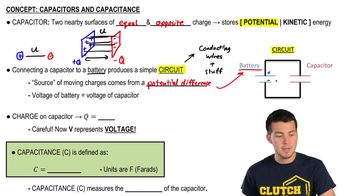
Capacitance

Capacitance is the ability of a system to store electric charge per unit voltage. It is defined as C = Q/V, where C is capacitance, Q is the charge stored, and V is the potential difference. In this scenario, the capacitance of the parallel plate capacitor changes as the distance between the plates is altered, affecting the charge on each electrode.
Video consigliato:
Percorso guidato
08:02
Capacitors & Capacitance (Intro)

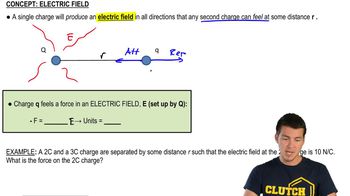
Electric Field

The electric field (E) between two charged plates is defined as the force per unit charge experienced by a positive test charge placed in the field. It is related to the potential difference (V) and the distance (d) between the plates by the equation E = V/d. Understanding the electric field is crucial for determining how the potential difference changes when the distance between the electrodes is modified.
Video consigliato:
Percorso guidato
03:16
Intro to Electric Fields

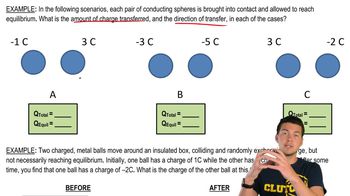
Charge Conservation

Charge conservation is a fundamental principle stating that the total electric charge in an isolated system remains constant. When the wires are disconnected from the battery, the charge on the electrodes becomes fixed. This principle is essential for calculating the charge on each electrode after the plates are pulled apart, as the total charge will not change despite the alteration in distance.
Video consigliato:
Percorso guidato
05:43
Conservation of Charge
Pratica correlata