
Ch 27: Current and Resistance
Knight Calc - Physics for Scientists and Engineers 5th Edition
Knight Calc5th EditionPhysics for Scientists and EngineersISBN: 9780137344796Non è quello che usi tu?Cambia libro di testo
Capitolo 27, Problema 75

A 300 μF capacitor is charged to 9.0 V, then connected in parallel with a 5000 Ω resistor. The capacitor will discharge because the resistor provides a conducting pathway between the capacitor plates, but much more slowly than if the plates were connected by a wire. Let t=0 s be the instant the fully charged capacitor is first connected to the resistor. At what time has the capacitor voltage decreased by half, to 4.5 V?

Guida verificata passo dopo passo
1
Identify the key components of the problem: The capacitor has a capacitance \( C = 300 \mu F = 300 \times 10^{-6} \; F \), the resistor has a resistance \( R = 5000 \; \Omega \), and the initial voltage across the capacitor is \( V_0 = 9.0 \; V \). The goal is to find the time \( t \) when the voltage across the capacitor decreases to \( V = 4.5 \; V \).
Recall the formula for the voltage across a discharging capacitor in an RC circuit: \( V(t) = V_0 e^{-t / \tau} \), where \( \tau = RC \) is the time constant of the circuit. Here, \( \tau \) represents the time it takes for the voltage to decrease to approximately 36.8% of its initial value.
Calculate the time constant \( \tau \): Substitute \( R = 5000 \; \Omega \) and \( C = 300 \times 10^{-6} \; F \) into the formula \( \tau = RC \). This gives \( \tau = 5000 \times 300 \times 10^{-6} \; s \).
Set up the equation for the voltage at time \( t \): Substitute \( V(t) = 4.5 \; V \), \( V_0 = 9.0 \; V \), and the expression for \( \tau \) into the formula \( V(t) = V_0 e^{-t / \tau} \). This gives \( 4.5 = 9.0 e^{-t / \tau} \).
Solve for \( t \): Divide both sides of the equation by \( 9.0 \), resulting in \( 0.5 = e^{-t / \tau} \). Take the natural logarithm of both sides to isolate \( t \): \( \ln(0.5) = -t / \tau \). Rearrange to find \( t \): \( t = -\tau \ln(0.5) \). Substitute the value of \( \tau \) calculated earlier to determine \( t \).

Risposta video verificata per un problema simile:

Questa soluzione video è stata consigliata dai nostri tutor come utile per risolvere questo problema.

Concetti chiave

Ecco i concetti essenziali che devi comprendere per rispondere correttamente alla domanda.

Capacitance

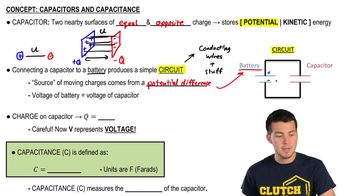
Capacitance is the ability of a capacitor to store charge per unit voltage, measured in farads (F). In this scenario, the 300 μF capacitor can store a significant amount of charge at 9.0 V. The capacitance determines how much energy can be stored and how quickly it can be released when connected to a circuit.
Video consigliato:
Percorso guidato
08:02
Capacitors & Capacitance (Intro)

RC Time Constant

The RC time constant, denoted as τ (tau), is a measure of the time it takes for the voltage across a capacitor to either charge or discharge to approximately 63.2% of its maximum value. It is calculated as τ = R × C, where R is the resistance in ohms and C is the capacitance in farads. This concept is crucial for understanding how quickly the capacitor voltage decreases over time.
Video consigliato:
Percorso guidato
08:59
Phase Constant of a Wave Function

Exponential Decay

Exponential decay describes the process by which the voltage across a discharging capacitor decreases over time, following the equation V(t) = V0 * e^(-t/τ). Here, V0 is the initial voltage, e is the base of the natural logarithm, and t is time. This concept helps in determining the specific time at which the voltage drops to half its initial value, which is essential for solving the given problem.
Video consigliato:
Percorso guidato
04:24
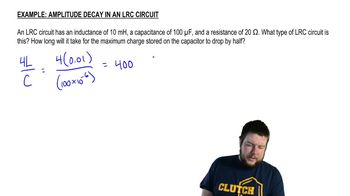
Amplitude Decay in an LRC Circuit