Ch 28: Fundamentals of Circuits
Knight Calc - Physics for Scientists and Engineers 5th Edition
Knight Calc5th EditionPhysics for Scientists and EngineersISBN: 9780137344796Non è quello che usi tu?Cambia libro di testo
Capitolo 28, Problema 50

A lightbulb is in series with a 2.0 Ω resistor. The lightbulb dissipates 10 W when this series circuit is connected to a 9.0 V battery. What is the current through the lightbulb? There are two possible answers; give both of them.

Guida verificata passo dopo passo
1
Step 1: Start by recalling the formula for power dissipation in terms of current and resistance: \( P = I^2 R \). Here, \( P \) is the power dissipated, \( I \) is the current, and \( R \) is the resistance. The lightbulb dissipates 10 W, so substitute \( P = 10 \) W into the equation.
Step 2: Rearrange the formula \( P = I^2 R \) to solve for \( I \): \( I = \sqrt{\frac{P}{R}} \). To proceed, you need the resistance of the lightbulb, which can be determined using the total voltage and the series circuit properties.
Step 3: Use Ohm's Law \( V = IR \) and the formula for total resistance in a series circuit: \( R_{total} = R_{resistor} + R_{lightbulb} \). The total voltage is 9.0 V, and the resistor has a resistance of 2.0 Ω. Let \( R_{lightbulb} \) represent the unknown resistance of the lightbulb.
Step 4: The total power dissipated in the circuit is shared between the resistor and the lightbulb. Use the relationship \( P = IV \) to express the current in terms of the total voltage and resistance. Substitute \( R_{total} \) into the equations to find \( R_{lightbulb} \).
Step 5: Once \( R_{lightbulb} \) is determined, substitute it back into \( I = \sqrt{\frac{P}{R}} \) to calculate the current through the lightbulb. Since there are two possible values for \( R_{lightbulb} \) (due to the quadratic nature of the equations), you will find two possible values for \( I \).

Risposta video verificata per un problema simile:

Questa soluzione video è stata consigliata dai nostri tutor come utile per risolvere questo problema.

Concetti chiave

Ecco i concetti essenziali che devi comprendere per rispondere correttamente alla domanda.

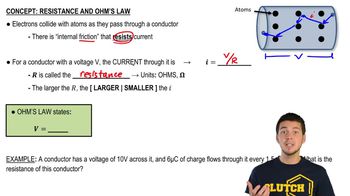
Ohm's Law

Ohm's Law states that the current (I) flowing through a conductor between two points is directly proportional to the voltage (V) across the two points and inversely proportional to the resistance (R) of the conductor. It is mathematically expressed as V = I * R. This principle is fundamental in analyzing electrical circuits, as it helps determine the relationship between voltage, current, and resistance.
Video consigliato:
Percorso guidato
03:07
Resistance and Ohm's Law

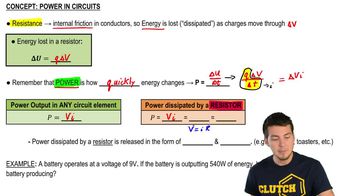
Power in Electrical Circuits

The power (P) dissipated in an electrical component, such as a lightbulb or resistor, is given by the formula P = V * I, where V is the voltage across the component and I is the current flowing through it. In this context, knowing the power dissipated by the lightbulb allows us to calculate the current using the voltage supplied by the battery, which is essential for solving the problem.
Video consigliato:
Percorso guidato
06:18
Power in Circuits

Series Circuits

In a series circuit, components are connected end-to-end, so the same current flows through each component. The total resistance in a series circuit is the sum of the individual resistances. This concept is crucial for understanding how the lightbulb and resistor interact in the circuit, as the total resistance affects the current and voltage distribution across each component.
Video consigliato:
Percorso guidato
05:55
LRC Circuits in Series
Pratica correlata
Domanda del libro di testo

What are the battery current Ibat and the potential difference V₁ - V₂ between points 1 and 2 when the switch in FIGURE P28.55 is (a) open and (b) closed?

170
views

Domanda del libro di testo

A small toaster that operates at 120 V has a heating element made from a 4.4-m-long, 0.70-mm-diameter nichrome wire. The resistivity, density, and specific heat of nichrome are, respectively, 1.5 x 10⁻⁶ Ωm, 8400 kg/m³, and 450 J/kg K. If half the heat energy is lost to the air, how long does it take the heating element to warm from 20℃ to 450℃, about the temperature at which it first begins to glow red?

1256
views
Domanda del libro di testo

Suppose you have resistors 2.5 Ω, 3.5 Ω, and 4.5 Ω and a 100 V power supply. What is the ratio of the total power delivered to the resistors if they are connected in parallel to the total power delivered if they are connected in series?

62
views
Domanda del libro di testo

Load resistor R is attached to a battery of emf and internal resistance r. For what value of the resistance R, in terms of ∈ and r, will the power dissipated by the load resistor be a maximum?

572
views
Domanda del libro di testo

A circuit you're building needs an ammeter that goes from 0 mA to a full-scale reading of 50 mA. Unfortunately, the only ammeter in the storeroom goes from 0 μA to a full-scale reading of only 500 μA. Fortunately, you've just finished a physics class, and you realize that you can make this ammeter work by putting a resistor in parallel with it, as shown in FIGURE P28.56. You've measured that the resistance of the ammeter is 50.0 Ω, not the 0 Ω of an ideal ammeter. What is the effective resistance of your ammeter?

63
views
Domanda del libro di testo

To which two points in the circuit of FIGURE P28.45 should a 12 V battery be connected to dissipate the most power?

76
views