
Ch 28: Fundamentals of Circuits
Knight Calc - Physics for Scientists and Engineers 5th Edition
Knight Calc5th EditionPhysics for Scientists and EngineersISBN: 9780137344796Non è quello che usi tu?Cambia libro di testo
Capitolo 28, Problema 42

An electric eel develops a 450 V potential difference between its head and tail. The eel can stun a fish or other prey by using this potential difference to drive a 0.80 A current pulse for 1.0 ms. What are (a) the energy delivered by this pulse and (b) the total charge that flows?

Guida verificata passo dopo passo
1
To calculate the energy delivered by the pulse, use the formula for electrical energy: E = V ⋅ I ⋅ t, where V is the potential difference (450 V), I is the current (0.80 A), and t is the time duration of the pulse (1.0 ms or 0.001 s). Substitute the given values into the formula to find the energy.
To calculate the total charge that flows, use the relationship between current, charge, and time: Q = I ⋅ t, where Q is the charge, I is the current (0.80 A), and t is the time duration of the pulse (1.0 ms or 0.001 s). Substitute the given values into the formula to find the total charge.
Ensure that the time is converted to seconds before substituting into the formulas, as the SI unit for time in these equations is seconds. For example, 1.0 ms = 0.001 s.
After substituting the values into the formulas, perform the multiplication to find the energy delivered and the total charge. Remember to keep track of the units to ensure consistency.
Finally, verify the results by checking the units of the calculated values. The energy should be in joules (J), and the charge should be in coulombs (C). This ensures that the calculations are dimensionally correct.

Risposta video verificata per un problema simile:

Questa soluzione video è stata consigliata dai nostri tutor come utile per risolvere questo problema.

Concetti chiave

Ecco i concetti essenziali che devi comprendere per rispondere correttamente alla domanda.

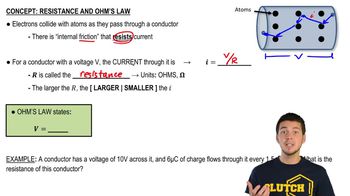
Ohm's Law

Ohm's Law states that the current (I) flowing through a conductor between two points is directly proportional to the voltage (V) across the two points and inversely proportional to the resistance (R) of the conductor. It is mathematically expressed as V = I × R. This principle is essential for understanding how electric circuits operate and is fundamental in calculating current, voltage, and resistance in various scenarios.
Video consigliato:
Percorso guidato
03:07
Resistance and Ohm's Law

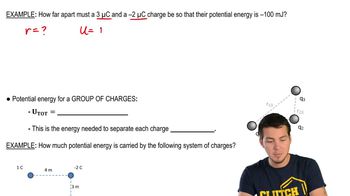
Electrical Energy

Electrical energy is the energy derived from electric potential energy or kinetic energy of charged particles. It can be calculated using the formula E = V × Q, where E is energy, V is voltage, and Q is charge. In the context of the electric eel, the energy delivered by the pulse can be determined by multiplying the potential difference by the total charge that flows during the pulse.
Video consigliato:
Percorso guidato
07:51
Electric Potential Energy

Charge Flow

Charge flow refers to the movement of electric charge, typically measured in coulombs (C). The total charge (Q) that flows can be calculated using the formula Q = I × t, where I is the current in amperes and t is the time in seconds. In the case of the electric eel, understanding how to calculate the total charge that flows during the pulse is crucial for determining the energy delivered to its prey.
Video consigliato:
Percorso guidato
11:08
Flow Continuity