Ch 28: Fundamentals of Circuits
Knight Calc - Physics for Scientists and Engineers 5th Edition
Knight Calc5th EditionPhysics for Scientists and EngineersISBN: 9780137344796Non è quello che usi tu?Cambia libro di testo
Capitolo 28, Problema 80

You’ve made the finals of the Science Olympics! As one of your tasks, you’re given 1.0 g of aluminum and asked to make a wire, using all the aluminum, that will dissipate 7.5 W when connected to a 1.5 V battery. What length and diameter will you choose for your wire?

Guida verificata passo dopo passo
1
Step 1: Calculate the resistance of the wire using the formula for power dissipation: \( P = \frac{V^2}{R} \). Rearrange the formula to solve for \( R \): \( R = \frac{V^2}{P} \). Substitute \( V = 1.5 \, \text{V} \) and \( P = 7.5 \, \text{W} \) into the equation.
Step 2: Use the formula for resistance in terms of resistivity: \( R = \rho \frac{L}{A} \), where \( \rho \) is the resistivity of aluminum, \( L \) is the length of the wire, and \( A \) is the cross-sectional area. Rearrange the formula to express \( L \) in terms of \( R \) and \( A \): \( L = \frac{R \cdot A}{\rho} \).
Step 3: Determine the cross-sectional area \( A \) of the wire using the formula for the area of a circle: \( A = \pi \frac{d^2}{4} \), where \( d \) is the diameter of the wire. Substitute this expression for \( A \) into the formula for \( L \).
Step 4: Use the density of aluminum (\( \rho_{\text{density}} = 2.7 \, \text{g/cm}^3 \)) to calculate the volume of the aluminum wire: \( V = \frac{m}{\rho_{\text{density}}} \), where \( m = 1.0 \, \text{g} \). Relate the volume to the length and cross-sectional area: \( V = L \cdot A \). Substitute \( A \) and \( L \) into this equation to express \( d \) in terms of \( R \), \( \rho \), and \( \rho_{\text{density}} \).
Step 5: Solve the system of equations to find the values of \( L \) and \( d \). Use the known values for the resistivity of aluminum (\( \rho = 2.82 \times 10^{-8} \, \Omega \cdot \text{m} \)) and the density of aluminum to complete the calculations.

Risposta video verificata per un problema simile:

Questa soluzione video è stata consigliata dai nostri tutor come utile per risolvere questo problema.

Concetti chiave

Ecco i concetti essenziali che devi comprendere per rispondere correttamente alla domanda.

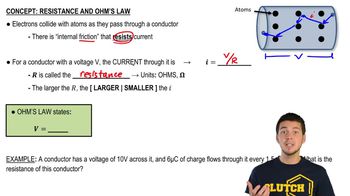
Ohm's Law

Ohm's Law states that the current (I) flowing through a conductor between two points is directly proportional to the voltage (V) across the two points and inversely proportional to the resistance (R) of the conductor. This relationship is expressed as V = IR. Understanding this law is crucial for determining how the wire will behave when connected to a voltage source.
Video consigliato:
Percorso guidato
03:07
Resistance and Ohm's Law

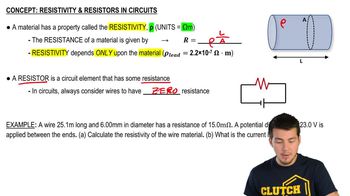
Resistivity

Resistivity is a material property that quantifies how strongly a given material opposes the flow of electric current. It is denoted by the symbol ρ (rho) and is dependent on the material's nature and temperature. For aluminum, the resistivity is relatively low, which means it is a good conductor. This concept is essential for calculating the resistance of the wire based on its dimensions.
Video consigliato:
Percorso guidato
05:25
Resistivity & Resistors in Circuits

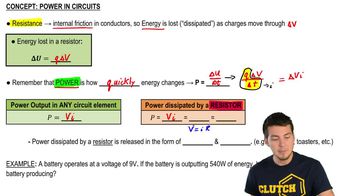
Power Dissipation

Power dissipation in an electrical circuit refers to the rate at which electrical energy is converted into heat energy, typically measured in watts (W). It can be calculated using the formula P = IV, where P is power, I is current, and V is voltage. In this scenario, understanding how to manipulate the wire's dimensions to achieve the desired power dissipation is key to solving the problem.
Video consigliato:
Percorso guidato
06:18
Power in Circuits